
Japanese Bread Knives: Why Serrated Matters More Than You Think
A Japanese bread knife does the same job as a Western one, but with better steel and a different approach to serrations. You get cleaner slices through hard crusts, less tearing of soft interiors, and fewer crumbs on the board.
If you have ever squashed a fresh loaf trying to cut it with a dull serrated knife, a Japanese bread knife is the fix. Here is what makes them different and what to look for.
What Makes a Japanese Bread Knife Different?
The main differences are steel quality, serration design, and blade geometry.
Better Steel
Japanese bread knives use the same high-grade steel found in other Japanese kitchen knives. Steels like AUS-10, VG-10, and Molybdenum rate higher on the Rockwell hardness scale (HRC 58-60+) compared to most Western serrated knives (HRC 54-56).
Harder steel means the serrations stay sharp longer. A cheap Western bread knife might cut well for a few months, then start to tear rather than slice. A good Japanese bread knife holds its edge for years.
The Yuzu Bread Knife uses AUS-10 steel at HRC 58-60, the same grade as our chef and vegetable knives. Our steel guide explains why this matters for edge retention.
Finer Serrations
Western bread knives tend to have deep, widely spaced, pointed teeth. These aggressive serrations grip well on very hard crusts but can shred softer bread. The pointed teeth dig in and rip rather than slicing cleanly.
Japanese bread knives often use finer, more closely spaced serrations. Some use a scalloped pattern rather than pointed teeth. This design still bites into crusty exteriors but transitions more smoothly through the soft crumb inside. You get neater slices with less damage to the bread's structure.
Thinner Blade
Like other Japanese knives, Japanese bread knives use a thinner blade than their Western counterparts. A thinner blade creates less friction as it passes through the loaf, which means less compression and less crumbing. This matters most with delicate breads like brioche, milk bread, or fresh sandwich loaves where a thick blade squashes the crumb flat.
What Can You Cut with a Bread Knife?
Despite the name, bread knives handle more than just loaves. The serrated edge is useful whenever you need to cut something with a tough exterior and a soft interior:
- Crusty bread: Sourdough, baguettes, ciabatta, and any loaf with a hard crust
- Tomatoes: The serrations grip the skin where a dull straight-edge blade would slip
- Citrus: Cutting through the tough rind of oranges, lemons, and grapefruit
- Cake layers: Levelling and splitting sponge cakes horizontally
- Pineapple and melon: Getting through the hard shell without crushing the flesh
- Roasted meats with bark: Slicing through a crispy crust on pork belly or brisket
A bread knife is one of those tools that turns out to be useful for more tasks than you would expect.
How Long Should a Bread Knife Be?
Blade length matters for bread knives more than most other types. You want the blade to be longer than whatever you are cutting so you can slice in a single sawing motion rather than chopping back and forth.
- 200-220mm (8-9 inches): Suitable for standard sandwich loaves, baguettes, and most home baking
- 240-260mm (9.5-10 inches): The sweet spot for serious bread bakers. Handles large sourdough boules and wider loaves comfortably
- 270mm+ (10.5+ inches): Professional territory. Useful in bakeries where you are slicing through very large loaves all day
The Yuzu Bread Knife has a 260mm blade, long enough for large sourdough rounds without being unwieldy for everyday use. For most home cooks, anything in the 240-260mm range works well.
Why Are Bread Knives Serrated?
Bread knives are serrated because the teeth grip hard crusts that a straight blade would slide across. Without serrations, you have to press down hard to break through the crust, which compresses the soft crumb underneath. Serrations bite into the surface immediately, so you can saw through with minimal downward pressure.
When you press a smooth blade against a hard bread crust, the blade skates along the surface until you apply enough downward force to break through. That force compresses the bread. Serrations work differently. The pointed or scalloped teeth catch the crust immediately, letting the blade bite in without pressure. Once the serrations break through the hard exterior, the blade glides through the soft interior.
This is why even a moderately sharp serrated knife cuts bread well, while even a razor-sharp straight-edge knife struggles with hard crusts like sourdough or ciabatta. The serration pattern matters too: finer, closely spaced scallops (common on Japanese bread knives) tear less than the aggressive pointed teeth found on cheap Western serrated knives.
The tradeoff is that serrated knives are harder to sharpen at home. But because the teeth do most of the cutting work and the recessed sections of the blade rarely contact food, serrated edges stay functional much longer than straight edges before they need professional attention.
Can You Sharpen a Serrated Knife?
Yes, but it is different from sharpening a straight-edge knife. You cannot use a flat whetstone on serrations because the flat surface will not reach inside the scalloped or toothed pattern.
The options:
- Ceramic sharpening rod: A thin, tapered rod that you work into each serration individually. This is the home method. Slow but effective.
- Professional sharpening service: Most knife sharpeners can handle serrated blades. Worth doing every couple of years if the knife has dulled noticeably.
- Replace when truly dull: With high-quality steel like AUS-10, this might not happen for many years of regular use.
For most people, a Japanese bread knife in good steel will stay sharp enough for home use long before you need to think about sharpening. The harder the steel, the longer the serrations last.
Choosing a Japanese Bread Knife: What to Look For
When picking a Japanese bread knife, focus on:
- Steel quality: AUS-10, VG-10, or similar. Avoid mystery "stainless steel" without a specific grade.
- Blade length: At least 240mm for versatility. Shorter blades limit what you can slice in a single stroke.
- Serration pattern: Finer, scalloped serrations over aggressive pointed teeth if you want cleaner cuts with less tearing.
- Handle comfort: You will use a sawing motion, so the handle needs to be comfortable during back-and-forth movement. A traditional wa handle (wooden Japanese style) tends to be lighter and more balanced than a heavy Western handle.
- Weight: Lighter is generally better for bread knives. The sawing motion means you are providing the force, and a heavy blade makes that tiring over time.
How the Yuzu Bread Knife Fits In
The Yuzu Bread Knife uses the same AUS-10 san-mai construction as the rest of the Yuzu range. The specs:
- Blade length: 260mm
- Total length: 400mm
- Blade width: 2mm
- Weight: 300g
- Steel: AUS-10 core with 430 stainless outer layers
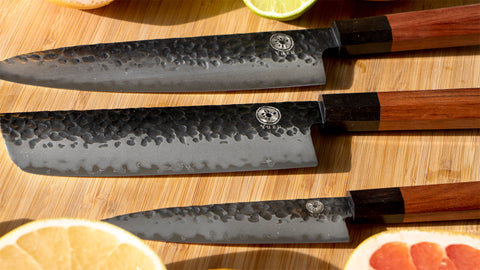
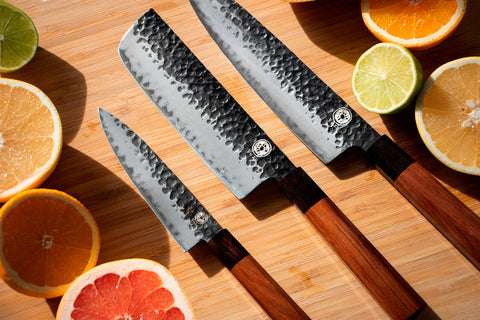
- Handle: Ebony and sandalwood wa handle
- Finish: Kurouchi (blacksmith's finish)
- Edge angle: 15 degrees
It is part of the Four Knife Set alongside the Gyuto, Nakiri, and Petty. Those four knives cover everything you need in a kitchen.
Caring for Your Bread Knife
Japanese bread knives need the same care as any Japanese knife:
- Hand wash only. Never put it in the dishwasher. The banging around will damage the serrations faster than years of normal use.
- Dry after washing. Even stainless steel benefits from being wiped dry rather than left in a drying rack.
- Store with protection. A wooden saya (sheath) or a knife block slot keeps the serrations from contacting other metal. A bread knife saya is worth having.
- Use the right surface. Cut on wood or plastic boards. Glass and ceramic boards will dull any knife fast, serrated or not.
Conclusion
A bread knife often gets treated as an afterthought, something cheap tossed into a block set. But if you bake your own bread, buy good sourdough, or just want clean slices without the mess, the knife matters. A Japanese bread knife with quality steel cuts cleaner, lasts longer, and handles more than just bread.
Harder steel, finer serrations, and a thinner blade mean you can slice through a crackling sourdough crust and come out the other side with the crumb intact. That is worth paying attention to.