
Japanese Kitchen Knives: The Complete Buyer's Guide
Japanese kitchen knives have a reputation for being some of the sharpest, most precise blades you can buy. They're thinner than Western knives, hold an edge longer, and weigh less in your hand. If you've been cooking with standard chef's knives and wondering what all the fuss is about, here's what actually makes Japanese knives different, and whether they're worth it for your kitchen.
What makes Japanese kitchen knives different?
The steel is harder. Japanese knives typically rate between 58-62 HRC on the Rockwell hardness scale, compared to 54-58 HRC for European blades. That extra hardness means the edge stays sharp longer between sharpenings.
The blades are thinner and lighter, sharpened at 10-15 degrees per side instead of 15-25 degrees. This narrower angle creates a sharper edge that glides through ingredients with less resistance. The difference is most obvious when you're slicing delicate fish or trying to get paper-thin vegetable cuts.
The cutting technique is different too. Western chef's knives use a rocking motion. Japanese knives work better with push-pull slicing movements. Once you get used to it, the technique produces cleaner cuts that don't crush or bruise what you're cutting.
What changes when you cook with Japanese knives
The spec sheet tells you a Japanese knife is harder and thinner. It doesn't tell you what that feels like at the board, which is the part that matters when you're deciding whether to switch.
The first thing you notice is that you stop pushing. A Western knife needs weight behind it, so you press down and let the blade wedge the food apart. Japanese cooking knives cut on contact. An onion falls open rather than splitting, and the layers stay where you put them.
Your grip changes too. Most people hold a Western chef's knife by the handle. Japanese knives balance further forward, so you end up pinching the blade between thumb and forefinger just ahead of the handle. It feels odd for about a day, then it feels obvious. You get more control at the tip and less strain in your wrist.
You'll also slow down before you speed up. Push-pull slicing takes a few sessions to learn. Once it clicks, prep gets quicker, because you're not fighting the knife or going back over cuts that didn't make it all the way through.
There's a catch. Japanese cooking knives are less forgiving than what you're used to. Twist one in a butternut squash and you can chip the edge. Leave it in the sink overnight and you'll find spots in the morning. None of that is hard to avoid. It's a habit change more than anything.
Types of Japanese kitchen knives for home cooks
Japanese culinary tradition has a specialized blade for just about every task. You don't need all of them. Here are the ones that actually matter for home cooking.
Gyuto: the Japanese chef's knife
The gyuto is where most people start. The name translates to "cow sword" from when these knives were used for cutting beef, but today it's just the Japanese version of a chef's knife, thinner and lighter than Western equivalents.
Gyuto knives range from 180mm to 240mm, with 210mm being the most versatile. The blade handles slicing, dicing, and chopping across all ingredient types. What sets it apart is the flatter blade profile near the heel, which works well for the push-pull cutting technique.
If you're buying your first Japanese knife, this is it. A good gyuto knife made with Japanese steel will handle 80% of your kitchen tasks. Our complete gyuto guide covers everything from blade profiles to cutting technique.
Nakiri: the vegetable specialist
The nakiri has a rectangular blade with a squared-off tip. The design is purely functional. The flat edge lets you cut straight down through vegetables without any rocking motion, and the tall blade makes it easy to scoop everything up when you're done.
If you prep a lot of vegetables, a nakiri knife with Japanese steel changes how you work. There's more on choosing and using one in our nakiri knife guide. The blade is usually 165-180mm with a thin profile that slices through dense vegetables like cabbage or squash with less effort. Most people who try one end up using it for all their vegetable work.
Petty knife: for precision work
The petty knife is small, 120-150mm, and handles tasks where a gyuto would be awkward. Peeling fruit, deveining shrimp, trimming fat, making garnishes. That sort of thing.
A petty knife crafted from Japanese steel is nimble enough for delicate work but still substantial enough to feel controlled. See our petty knife guide for sizes and uses. Professional chefs tend to keep one close by throughout service.
Bread knife: not just for bread
Japanese bread knives use the same thin, precise construction as other Japanese blades. The serrated edge cuts through crusty bread without crushing the interior, but it also works well for tomatoes, citrus, and cakes.
A good bread knife made with Japanese steel is usually 230-260mm with a flexible blade that follows contours. Our bread knife article explains why serration design matters more than most people think. The serrations stay sharp longer than what you'd find on most Western bread knives.
What size Japanese kitchen knife should you buy?
Size trips up more first-time buyers than steel does. Japanese knives are sold by blade length in millimetres, and the numbers run shorter than the Western knife you'd pick for the same job.
For a gyuto, 210mm suits most home kitchens. Go up to 240mm if you regularly break down large cuts of meat or cook for a crowd. Drop to 180mm if your board is small, or if the longer blade feels unwieldy when you try it. The gap between 210mm and 240mm looks minor written down. In the hand it's obvious.
Nakiri sizing barely matters. Anything in the usual range works, and the real question is how much knuckle clearance you want above the board.
Petty knives split into two camps. A short one is a paring knife you can use on a board. A long one starts to overlap with a small gyuto, which is useful if you'd rather own one knife than two.
Measure your chopping board before you buy anything longer than 210mm. A blade that overhangs the board is awkward to use, and you'll quietly go back to the shorter knife every time.
Understanding Japanese knife steel
Steel type determines how the knife performs and how much work it takes to maintain. Japanese knives use three main categories.
High carbon stainless steel
This is the best option for most home cooks. High carbon stainless blends the hardness and edge retention of carbon steel with the easier maintenance of stainless. AUS-10 steel, for example, rates 58-60 HRC and resists rust while staying sharp.
You get excellent performance without having to baby the knife. No patina to worry about, no frantic drying after every use.
Carbon steel
Traditional carbon steel can be even harder (60-65 HRC) and takes the sharpest possible edge. Sushi chefs often prefer these blades for the cutting performance.
The tradeoff is maintenance. Carbon steel reacts with acidic ingredients and moisture, developing a patina over time. You need to dry it carefully after every use to prevent rust. These knives are for people who enjoy the ritual of knife care.
Stainless steel
Basic stainless is the easiest to maintain but can't match the hardness and edge retention of the other options. Modern stainless formulations have improved, but they're generally the choice when convenience matters more than peak performance.
How to tell if a Japanese knife is good quality
Steel hardness is the first thing to check. Japanese kitchen knives should be HRC 58 or above. Anything below 56 and the edge dulls too quickly to justify the price. Most reputable brands list their HRC rating. If a knife doesn't mention it, that's not a good sign.
Blade thickness should be under 2mm at the spine for most kitchen knives. Thicker blades split food apart rather than slicing through it. Pick up the knife and look at the blade from above. You can see the difference between 1.5mm and 3mm without measuring.
Look at where the blade meets the handle. The junction should be tight with no visible gaps. Run your finger around it. If you feel a ridge or a gap, the assembly is sloppy. The tang (the metal that extends into the handle) should sit secure without any wobble.
Hold the knife at eye level and sight down the edge. It should run straight and even from heel to tip. An uneven grind means one side is thicker, which pulls the blade off-line during cuts and makes sharpening harder.
Handle materials tell you something too. Solid wood (magnolia, ebony, sandalwood) is lighter and more comfortable over long sessions. Plastic or composite handles work, but they tend to feel heavier and cheaper. Check the balance by holding the knife in a pinch grip. It should rest level, not diving toward the blade or tipping back toward the handle.
What is san-mai construction?
Many Japanese knives use san-mai construction, a three-layer blade design. The core is hard, high-carbon steel that forms the cutting edge. Two outer layers of softer, more corrosion-resistant steel sandwich that core.
The result: the hard core holds a sharp edge while the outer layers protect against rust and add toughness. The contrast between layers also creates the pattern you see on many Japanese knives.
San-mai is traditional Japanese bladesmithing adapted for kitchen use. You get high performance without all the maintenance headaches of solid carbon steel.
Traditional Japanese handle styles
The wa-handle is the traditional style. Unlike Western handles that rivet onto the blade, wa-handles slide onto the tang and lock in place with friction (sometimes epoxy too).
These handles are usually wood: magnolia, ebony, or sandalwood. The octagonal or D-shaped cross-section gives you a secure grip that won't rotate during use. The lightweight handle balances well with the thin blade, so your hand doesn't get tired during long prep sessions.
Some Japanese knives come with Western-style handles if you prefer something more familiar. Neither is better. Just pick what feels comfortable.
What Japanese knives do I need?
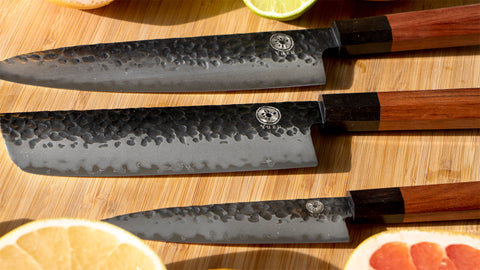
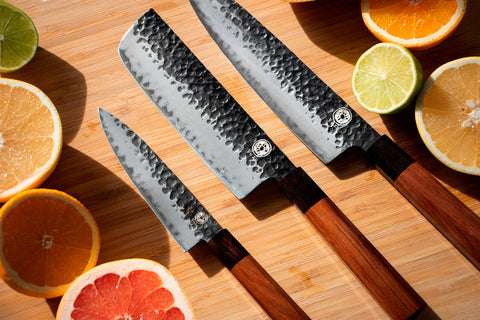
Most home cooks need three knives. Not twelve, not six. Three. A gyuto for general prep and proteins, a nakiri for vegetables, and a petty for detail work. That combination covers roughly 95% of what happens on a cutting board.
The gyuto earns its place immediately. It handles every ingredient type, from proteins to aromatics. If you only buy one Japanese knife, this is the one. The nakiri earns its place once you notice how much vegetable prep you actually do. If you're dicing onions, shredding cabbage, or breaking down squash more than a couple of times a week, the nakiri's flat blade and straight-down cutting motion will feel like an upgrade you should have made sooner.
The petty handles everything the gyuto is too large for. Peeling ginger, trimming fat off a chicken breast, scoring fish skin, cutting garnishes. It's the knife that lives within arm's reach.
A bread knife is worth adding if you buy whole loaves regularly or bake your own. The serrated edge cuts through hard crusts without crushing the crumb, and it works well on tomatoes and citrus too. Beyond these four, you're into specialist territory that most home kitchens don't need.
Start with the gyuto. Cook with it for a few weeks, pay attention to which tasks feel awkward, and let that tell you what to add next.
How to choose your first Japanese kitchen knife
Start with a gyuto. It handles more of your prep than any other shape, and it teaches you how Japanese knives want to be used before you spend money on anything specialised.
Look for high carbon stainless steel like AUS-10 or VG-10. These steels perform well without the intensive maintenance of traditional carbon steel. Our AUS-10 vs VG-10 comparison can help you decide between them. They're good for learning how Japanese knives work before you invest in more specialized options.
Consider a set that covers the basics. A three knife set crafted from Japanese steel with gyuto, nakiri, and petty will handle virtually everything you cook. Sets usually cost less than buying individual knives.
Caring for Japanese kitchen knives
Japanese knives need more care than typical Western knives, but the routine is simple.
Don't put them in the dishwasher. The harsh detergents and high heat damage both blade and handle. Hand wash with warm water and mild soap right after use. Dry completely before storing.
Don't cut on glass, marble, or ceramic boards. These hard surfaces dull the edge fast. Use wood or soft plastic cutting boards.
Don't use Japanese knives on frozen foods, bones, or other hard stuff. The hard, thin blades can chip under lateral stress or impact. Keep a Western-style knife around for tougher tasks.
Sharpen regularly on whetstones rather than honing rods. Our whetstone sharpening guide walks you through the process. The harder steel responds better to abrasive sharpening. A dual-sided whetstone with 1000 and 6000 grit stones covers sharpening and polishing.
Storing them properly
Loose in a drawer is the quickest way to chip an edge. The blade knocks against everything else in there every time you open it.
A magnetic strip on the wall works well and keeps the knives where you can see them. Lay the blade flat against it rather than tapping the edge on. A block is fine too, as long as the slots don't drag the edge on the way in.
If the knives have to live in a drawer, use a saya. It's a wooden sheath that covers the blade, and it's the traditional answer to this exact problem. Our guide to the saya covers sizing and when it's worth bothering.
Common mistakes when buying Japanese kitchen knives
Most of the regret we hear about follows the same few patterns.
Buying the full set before you know what you use. A block of eight looks like value, and then five of them sit in the drawer for years. Buy one good knife, cook with it, and let the gaps tell you what to add. You spend less overall and you end up with knives you actually reach for.
Chasing the hardness number. HRC 62 reads better than HRC 59 and holds an edge longer on paper. It also chips more easily and takes longer to bring back when it does go dull. For home cooking, HRC 58-60 is the sensible range. Above that is for people who enjoy sharpening as a hobby.
Ignoring the handle. Steel gets all the attention, but the handle is the part you're holding for twenty minutes while you prep dinner. If you have large hands, a slim wa handle can feel cramped, and no amount of good steel fixes that.
Expecting one knife to do everything. It won't. Keep a cheap, tough Western knife for bones, frozen food and anything you'd wince at doing with a thin blade. That one knife protects everything else you own.
Buying without a way to sharpen. A Japanese knife that never gets sharpened is just an expensive knife that's gone blunt. Budget for a stone at the same time, not a year later.
Trusting the word "Japanese" on its own. Plenty of knives are sold as Japanese-style while being made from soft steel and a good photograph. Check the steel type and the HRC rating. If a listing mentions neither, there's usually a reason.
Common questions about Japanese kitchen knives
Are Japanese knives worth the investment?
If you cook regularly and care about precision, yes. The sharper edge and better edge retention mean less time fighting with dull knives. Quality Japanese knives last decades when maintained properly, so the cost spreads out over many years.
Can left-handed cooks use Japanese knives?
Most Japanese kitchen knives have double-bevel edges that work fine for both right and left-handed users. The gyuto, nakiri, and petty all fall into this category. Some specialized traditional knives like the yanagiba have single-bevel edges ground for right-handed use, but you don't need those for home cooking.
How often do Japanese knives need sharpening?
Depends how much you cook and how you treat the edge. With regular use, expect to sharpen every 2-3 months. Proper cutting board choice and careful use extend that timeline. You'll know it's time when the knife needs more pressure to cut cleanly.
What's the difference between a gyuto and a santoku?
Both are general-purpose Japanese knives with different profiles. The gyuto has a pointed tip and longer blade, better for detailed work and slicing. The santoku is shorter with a straighter edge and rounded tip, designed for up-down chopping. The gyuto is more versatile, but plenty of cooks like both.
Best Japanese knife for home use
If you're buying one Japanese knife for home cooking, get a gyuto. It does everything a Western chef knife does, just thinner and sharper.
The Yuzu Gyuto is AUS-10 steel with san-mai construction at £109. It's the same steel and build quality you'd find in knives costing £150-200 from other Japanese knife brands. If you're switching from a Western chef knife, the gyuto is the closest in function but noticeably sharper and lighter.
If you cook a lot of vegetables, add a nakiri as your second knife. The Yuzu Nakiri is the same price and steel, built specifically for vegetable prep. Between a gyuto and a nakiri, you have most home cooking covered.
For the best value, the three knife set (gyuto, nakiri, petty) costs £229 instead of £293 bought separately. That's a full kitchen setup for less than what some brands charge for a single knife.
Building your Japanese knife collection
Buy in the order you'll use them. Gyuto first, then whichever gap you keep running into. If you'd rather start with the set and skip the decisions, our guide to Japanese knife sets covers what belongs in one and whether a set beats buying piece by piece. The four knife set made with Japanese steel is the one we'd point most people at.
Japanese kitchen knives change how food prep feels. The sharper edges, lighter weight, and better balance make cooking more enjoyable. Start with the basics, learn to sharpen properly, and you'll get why chefs prefer these blades.