
Japanese Knife Sheaths: What Is a Saya and Why Use One?
A saya is a wooden sheath designed to protect a Japanese knife's blade when it is not in use. The word comes from the Japanese term for scabbard, the same kind used for samurai swords, scaled down for kitchen knives.
If you own a good Japanese knife, a saya keeps the edge from contacting other metal in drawers, prevents accidental cuts when reaching into storage, and protects the blade during transport. It is one of the cheapest ways to extend the life of an expensive knife.
What does a saya do?
A saya solves a few problems at once:
- Edge protection. The cutting edge never touches anything hard. No metal-on-metal contact in a drawer, no clanging against other knives. The edge stays sharp longer because it is not getting dinged up between uses.
- Safety. Japanese kitchen knives are thin and extremely sharp. Reaching into a drawer and brushing against an exposed blade is how kitchen cuts happen. A saya covers the edge completely.
- Moisture control. Wood absorbs and releases moisture naturally. A saya helps buffer humidity around the blade, which matters for carbon steel knives that rust easily. The wood pulls moisture away from the steel rather than trapping it against the surface.
- Transport. If you carry knives to work, to a friend's house, or to a cooking class, a saya protects the blade in your bag without needing a full knife roll.
The protection a saya provides is passive. You slide the knife in, and the wood does the rest. No latches, no magnets, no mechanisms.
What is a saya made from?
Traditional sayas are made from magnolia wood, known in Japanese as "ho" or "ho-no-ki." Magnolia has been the standard since at least the Heian period (around 800 AD), and for good reason.
Magnolia is soft enough that it will not scratch or damage a blade, even after years of sliding the knife in and out. It has an open grain structure that absorbs excess moisture without holding it, so the blade stays dry. And it contains no corrosive resins or tannins that could react with steel, unlike woods such as oak or walnut which can discolour and corrode blades over time.
You will also see sayas made from:
- Poplar: A budget alternative to magnolia. Similar softness and low reactivity, but less moisture regulation.
- Cedar: Sometimes used for its pleasant smell, though less common for kitchen knives.
- Cherry (sakura): Occasionally used for presentation pieces. Harder than magnolia.
Plastic blade guards exist too, but they trap moisture against the blade and can scratch softer steels. For Japanese knives, wood is the better choice.
How a saya fits
A good saya is carved to match a specific blade shape. The knife slides in along the spine (the thick, non-cutting side) and the wood holds the blade by friction. A small wooden pin called a mekugi passes through a hole in the saya and rests against the handle to keep the knife from sliding out.
The fit should be snug but not tight. You want to be able to remove the knife with one hand by pushing the mekugi aside and pulling, but not so loose that the knife falls out if the saya tips over.
If your saya is too tight, lightly sand the interior with fine sandpaper. If it is too loose, a thin wooden shim near the mouth of the saya will tighten the fit. Small fit adjustments are normal as the wood settles over the first few weeks.
Saya vs blade guard vs knife roll
There are a few ways to protect a knife blade. Each works differently.
A saya covers the blade with wood, protects the edge completely, and lets the blade breathe. It works for drawer storage, transport, and long-term protection. Downside: it fits one specific knife profile, so you need one per knife.
A plastic blade guard is cheap and universal. You can buy one for a few pounds and it fits most blade shapes. But plastic traps moisture, which can cause rust spots on reactive steel. Plastic guards also tend to scratch softer metals over time. Fine for a Victorinox, not ideal for a Japanese knife.
A knife roll holds multiple knives in fabric pockets for transport. Good for carrying a kit to work. But the fabric offers less impact protection than wood, and knives can shift around and contact each other unless each one has its own saya or guard inside the roll. Many professional chefs use sayas inside a knife roll for the best of both worlds.
A magnetic strip mounted on a wall keeps knives visible and accessible. No drawer contact, no moisture trapping. The downside is magnets can scratch blades if you are not careful placing and removing them. And they are useless for transport.
For Japanese kitchen knives specifically, a saya is the best single solution. It protects the edge, manages moisture, and works both at home and on the move.
How to care for your saya
A saya is low maintenance, but there are a few things that will keep it in good shape:
- Always dry the knife before inserting it. This is the most important rule. A wet blade sitting inside a wooden sheath creates the perfect environment for rust. Wash your knife, dry it completely with a towel, and then put it away.
- Wipe the saya occasionally. Use a dry cloth to clean the inside every few months. If the inside feels damp or smells musty, leave the saya open to air dry for a day.
- Oil the wood once or twice a year. A light coat of food-safe mineral oil on the exterior prevents the wood from drying out and cracking. Do not soak it. Just a thin wipe with an oiled cloth.
- Store in a dry place. Avoid leaving your saya in direct sunlight or near a stove where heat can warp the wood. A kitchen drawer at room temperature is fine.
- Insert spine-first. Slide the knife in along the spine, not edge-first. Edge-first insertion will eventually carve grooves in the wood and loosen the fit.
Do you need a saya?
Not every knife needs one. If your knives live on a magnetic wall strip or in a knife block with individual slots, the blades are already protected. A saya adds the most value when:
- You store knives in a drawer (where they contact other utensils)
- You transport knives outside your kitchen
- You own carbon steel or reactive steel knives that need moisture management
- You want to protect an expensive knife from accidental damage
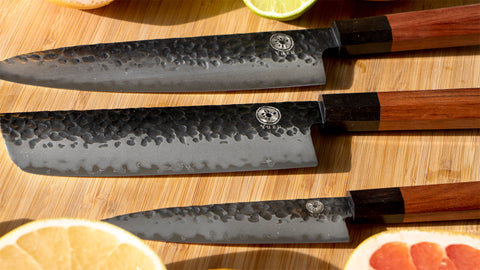
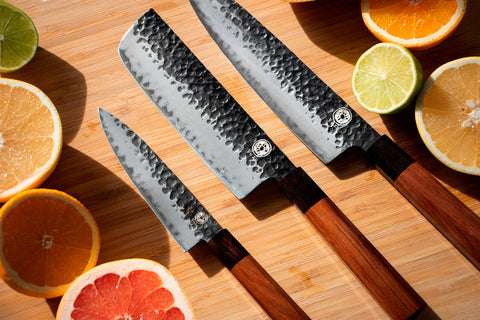
For Yuzu knives with AUS-10 san-mai construction, a saya is worth having. The AUS-10 core is stainless, but the kurouchi finish on the outer 430 steel layers can react to prolonged moisture. A saya keeps everything dry and protected.
Yuzu sayas
Yuzu makes wooden sayas sized for each knife in the range:
- Gyuto saya (fits the 205mm blade)
- Nakiri saya
- Petty saya
- Bread knife saya
Individual sayas are £19 each. If you need more than two, the three-saya bundle is £45 (saving £12) and the four-saya bundle is £59 (saving £17). The starter kits also include a saya matched to the knife.
The bottom line
A saya is a simple piece of wood that does a lot of work. It keeps your knife's edge intact, prevents rust, stops you from cutting yourself in a drawer, and travels well. At £19, it is the cheapest insurance you can buy for a good knife.
Dry the blade, slide it in, and forget about it until you need the knife again. That is all there is to it.