
Japanese Paring Knives: Precision in a Small Package
A Japanese paring knife (called a "petty knife" in Japan) is a small utility knife with a blade typically 90-150mm (3.5-6 inches) long. It's used for precision tasks like peeling fruit, trimming vegetables, and any detailed knife work that requires control rather than power.
Japanese versions are sharper, lighter, and thinner than Western paring knives. The harder steel (typically 58-60 HRC) holds a finer edge, and the blade geometry makes them better for clean, precise cuts.
This guide explains what makes Japanese paring knives different, when to use them, and how to choose one.
Petty Knife vs Paring Knife: What's the Difference?
In Japan, small precision knives are called petty knives (from the French "petit," meaning small). In the West, we call them paring knives. They serve the same purpose, but there are differences.
Size
Western paring knives typically measure 7-10cm (2.8-4 inches). Japanese petty knives start at about 9cm but commonly run 12-15cm (4.7-6 inches), making them slightly larger and more versatile.
The extra length means a Japanese petty can handle small chopping jobs on a cutting board, not just in-hand peeling work. Our petty knife guide goes deeper on what makes these knives useful.
Blade Thickness and Weight
Japanese paring knives are thinner and lighter. Where a Western paring knife might have a 2-3mm spine, a Japanese petty is often 1.5-2mm. This makes them nimbler but requires a lighter touch.
Steel and Hardness
Japanese paring knives use harder steel (58-60 HRC for stainless like AUS-10, up to 62-64 HRC for carbon steel). Western paring knives typically sit at 54-58 HRC.
Harder steel means the edge stays sharper longer but requires more careful use. Don't use a Japanese petty to pry or twist.
Blade Geometry
Japanese paring knives have a flatter blade profile and thinner grind behind the edge. This reduces friction when cutting and makes the blade feel sharper even at the same actual edge angle.
What Are Japanese Paring Knives Used For?
Any task where you need precision over power. The petty knife excels at:
Peeling and Trimming
Hold an apple, potato, or carrot in one hand and peel with the petty in the other. The sharp tip and light weight give you control. You remove just the skin, wasting less of the fruit or vegetable.
Also good for trimming fat from meat, removing stems from herbs, and cleaning mushrooms.
Coring and Deseeding
Core tomatoes, hull strawberries, deseed peppers. The pointed tip gets into tight spaces without tearing the flesh around it.
Scoring and Decorative Work
Score bread dough, make decorative cuts in vegetables, or create garnishes. The thin blade and light weight give you the control needed for detailed work.
Small Chopping Tasks
Unlike Western paring knives, Japanese petty knives (especially the 12-15cm versions) work on a cutting board. Slice a few cloves of garlic, dice a shallot, or brunoise a carrot without switching to your chef's knife.
The Yuzu petty knife at 120mm hits the sweet spot for both in-hand and on-board work.
Blade Profiles: Three Main Types
Standard Profile
Looks like a miniature chef's knife with a gently curved belly. This is the most common and versatile type. You can rock-chop with it or use it for straight cuts.
Most Japanese petty knives, including Yuzu's, use this profile.
Bird's Beak (Tourné)
Features a curved, hook-shaped blade. Used primarily for turning vegetables (creating football-shaped cuts) and decorative work. Less versatile for general use.
Common in French cuisine but less popular for everyday kitchen work.
Sheepsfoot
Has a straight edge with no belly curve. The tip is blunt rather than pointed. Good for straight slicing but less useful for peeling or coring.
Least common for kitchen paring knives.
Choosing the Right Size
Japanese paring knives come in several sizes:
90-100mm (3.5-4 inches)
Smallest option. Best for delicate decorative work and in-hand peeling only. Too small for most general kitchen tasks.
120-135mm (4.7-5.3 inches)
Most versatile size. Handles both in-hand peeling and small cutting board work. Works as a utility knife for everyday tasks.
This is the size most home cooks should choose.
150mm (6 inches)
Larger end of the petty range. Starts to overlap with small chef's knives. Good if you want one knife for small to medium tasks.
Can feel too large for delicate peeling work.
Steel Options for Japanese Paring Knives
High-Carbon Stainless (VG-10, AUS-10)
Best for most users. Gets sharp, holds an edge well, and resists rust. Requires less maintenance than pure carbon steel.
Yuzu's petty knife uses AUS-10 steel at 58-60 HRC. This is hard enough to hold a fine edge but not so hard it chips easily.
Carbon Steel (White Steel, Blue Steel)
Gets slightly sharper than stainless and easier to sharpen, but rusts if you don't dry it immediately. Develops a patina over time.
Good if you enjoy hands-on knife maintenance. Not ideal if you sometimes forget to dry your knives.
VG-MAX, SG2, Damascus
Premium stainless options that get very sharp and hold edges longer. More expensive. Diminishing returns for casual users.
Handle Styles
Wa Handle (Japanese Style)
Traditional wooden handle, often octagonal or D-shaped. Lighter weight and smaller diameter than Western handles, which suits the petty's delicate work.
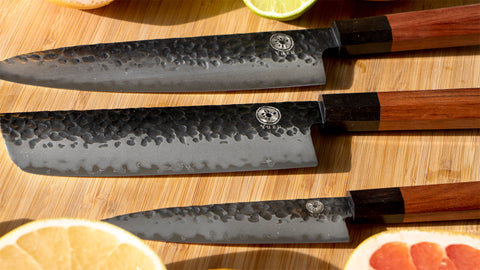
Made from ebony, sandalwood, or stabilized wood. The Yuzu petty uses an ebony and sandalwood wa handle for a secure grip.
Western Handle
More common on hybrid Japanese-Western knives like Shun. Familiar feel for Western users but can feel bulky on a small knife.
Which to Choose?
Wa handles suit the petty knife's purpose better. The lighter weight and smaller diameter give you more control for precision work.
Care and Maintenance
Washing
Hand wash only. Dry immediately. The thin blade can chip or rust if mistreated.
Don't put Japanese knives in the dishwasher, even stainless ones. The detergent and heat can damage the edge and handle.
Sharpening
Japanese petty knives are typically sharpened to 15 degrees per side (compared to 20 degrees for Western knives). Use a whetstone to maintain this angle.
The small blade makes sharpening quick. You can sharpen a petty in 5-10 minutes.
Storage
Don't toss it in a drawer where it can bang against other utensils. Use a knife block, magnetic strip, or wooden saya (sheath) to protect the edge.
Do You Need a Japanese Paring Knife?
If you already own a chef's knife, a petty is the next most useful knife in your kitchen. It handles all the small tasks where a chef's knife feels too big and clumsy.
Compared to a Western paring knife, a Japanese petty is sharper out of the box and stays sharp longer. It's lighter and easier to control for long periods. The extra length makes it more versatile, and the thinner blade feels sharper when cutting.
The tradeoff is that they're more delicate. Don't use a petty knife to pry open containers, twist cores out of vegetables, or cut frozen food. The thin blade can chip.
Who Should Get One?
You prep a lot of vegetables and fruits. You do detailed knife work like brunoise cuts or garnishes. You want a knife that feels like an extension of your hand rather than a tool you're wrestling with.
You already appreciate sharp knives and take care of them.
Who Can Skip It?
You rarely cook. You're rough on your knives. You already own a Western paring knife that works fine and don't care about the performance difference.
Petty Knife vs Other Small Japanese Knives
Petty vs Utility Knife
These are the same knife. "Utility knife" is the Western term, "petty" is the Japanese term. Some manufacturers use both names interchangeably.
Petty vs Honesuki
A honesuki is a Japanese boning knife with a triangular blade and sturdy construction. It's designed for breaking down poultry, not for delicate work.
Different purposes entirely.
Petty vs Ko-Bunka
A ko-bunka is a small version of a bunka knife (a Japanese multipurpose knife with a reverse-tanto tip). It's less common than petty knives and slightly less versatile for peeling work due to the tip shape.
Where Japanese Paring Knives Fit in Your Knife Set
A well-rounded Japanese knife set for home cooking includes a gyuto (chef's knife) for general cutting, a nakiri for efficient vegetable prep, a petty for precision and small tasks, and a bread knife for crusty loaves.
This covers 95% of home cooking needs. The Yuzu four-knife set includes all four at a discount.
If you're building a set one knife at a time, get the gyuto first, then the petty.
The Bottom Line on Japanese Paring Knives
Japanese paring knives (petty knives) are sharper, lighter, and more precise than Western versions. The harder steel and thinner blade geometry make them better for detailed work.
They're more delicate than Western knives and require hand washing and proper storage. But if you do a lot of vegetable prep or precision cutting, the performance difference is worth the extra care.
Look for a 120-135mm blade in high-carbon stainless steel (like AUS-10) with a wa handle. This size and spec handles both in-hand peeling and small chopping tasks.
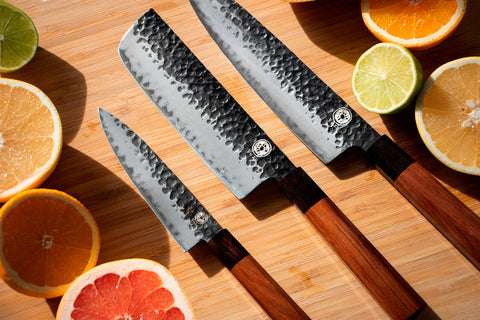
The Yuzu petty knife fits this description at £75, or get it as part of the three-knife set with a gyuto and nakiri for £229.