
Gyuto vs Chef Knife: What's the Actual Difference?
A gyuto and a Western chef knife do the same job. Both are all-purpose kitchen blades for slicing, dicing, and chopping. But they're built differently, and those differences change how they feel in your hand and what they're good at.
If you've only ever used a Western chef knife, picking up a gyuto for the first time feels noticeably different. Lighter, thinner, sharper. The cutting motion changes too. Here's what actually matters when comparing the two.
Blade thickness and weight
This is the difference you notice first. A typical Western chef knife is 2.5-3mm thick at the spine. A gyuto runs 1.5-2mm. That sounds minor, but pick up both and you'll feel it immediately.
The thinner blade cuts with less resistance. Slice a ripe tomato with a gyuto and the blade glides through. Do the same with a thicker German blade and you're pushing harder, wedging the tomato apart rather than slicing it cleanly.
Weight follows the same pattern. A 210mm Western chef knife weighs 280-320g. A gyuto the same length weighs 200-260g. After thirty minutes of prep, the lighter blade is noticeably easier on your wrist.
Edge angle and sharpness
Western chef knives are sharpened at 20-22 degrees per side, giving a total included angle of 40-44 degrees. Gyutos are sharpened at 12-15 degrees per side, totalling 24-30 degrees.
The narrower angle is sharper. It separates food fibres rather than tearing through them. You see this most clearly on herbs (less bruising), fish (cleaner slices), and soft vegetables.
The trade-off is durability. A thinner edge is more prone to chipping if you hit something hard, like a bone or a frozen surface. Western edges are more forgiving of rough use. If you tend to use your knife as a pry bar or scraper, the Western angle holds up better.
Steel hardness
Gyutos use harder steel, typically 58-62 HRC on the Rockwell scale. Western chef knives sit at 54-58 HRC.
Harder steel holds its edge longer. A gyuto made from AUS-10 steel (58-60 HRC) stays sharp noticeably longer than a softer German stainless blade. You sharpen less often.
The flip side: harder steel is more brittle. You can't flex a gyuto the way you might bend a Western boning knife. Lateral pressure, twisting, or prying can chip the blade. Treat it as a precision tool, not a multi-purpose lever.
Cutting technique
This is where most people need a day or two to adjust.
A Western chef knife has a pronounced curve (belly) along the edge. It's designed for rocking: you keep the tip on the board and rock the blade heel-to-tip through the ingredient. The curved profile makes this motion natural.
A gyuto has a flatter profile. It works better with push-cuts and pull-cuts, where you drive the blade forward and down through the food in a single motion. The flat section contacts the board all at once, which is faster for chopping once you get the rhythm. Our gyuto chef knife guide covers these techniques in more detail.
Most gyutos still have some curve near the tip, so you can rock-chop when needed. But the flat section is longer, and the blade rewards a different motion than what Western cooks learn first.
Handle design
Western chef knives use riveted handles, often synthetic or hardwood, with a full tang running the length of the handle. They feel solid, heavy, and balanced toward the middle of the knife.
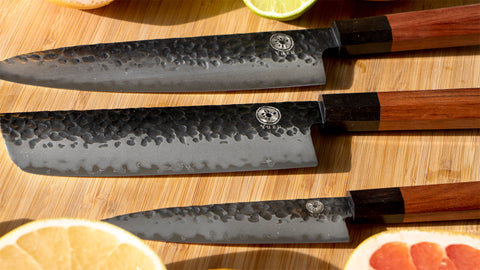
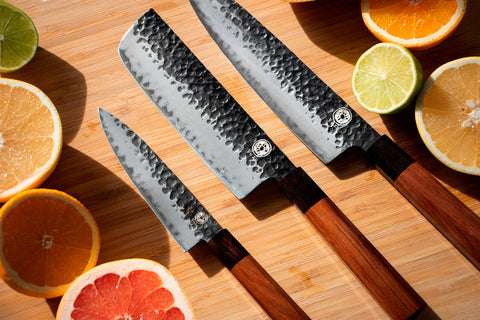
Traditional gyutos use Japanese wa handles: lightweight wood (often magnolia, ebony, or sandalwood), octagonal or D-shaped, with the tang burned in rather than riveted. The balance shifts forward toward the blade, which gives you more control over the cutting edge.
Some gyutos come with Western-style handles. Personal preference matters more than performance here. If you already own other knives with wa handles, matching them keeps your grip consistent.
Maintenance
Western chef knives are generally lower maintenance. The softer steel is easy to hone with a steel rod, and the thicker blade is less fragile.
Gyutos need more care. The harder steel doesn't respond well to honing steels (ceramic rods work, regular steel rods can chip the edge). Whetstone sharpening is the preferred method, and you need to be gentler with the thin blade. No dishwashers, no glass cutting boards, no bones.
That said, hard steel stays sharp much longer between sharpenings. You sharpen less often but more carefully.
Which should you choose?
If you cook daily and want the sharpest, lightest blade possible, a gyuto is the better tool. The thinner edge, harder steel, and lighter weight make prep faster and more precise. You just need to treat it properly: hand wash, wood or plastic boards, whetstone sharpening.
If you want something tougher and lower-maintenance, a Western chef knife is more forgiving. It handles rough use, goes through the dishwasher (though you shouldn't), and sharpens easily on a honing rod.
Many cooks end up owning both. The gyuto for everyday prep where precision matters. The Western knife for heavier jobs or when you don't feel like being careful.
Our Yuzu gyuto is a good starting point if you're making the switch. AUS-10 steel in san-mai construction, 205mm blade, wa handle. At £109, it costs less than most Western chef knives from the big German brands. The gyuto starter kit (£149) includes a whetstone and protective saya if you're starting from scratch.