
The Gyuto Knife: Master the Japanese Chef's Knife
A gyuto knife is the Japanese version of the Western chef's knife. It's an all-purpose blade for slicing, dicing, and chopping. The name translates to "cow sword" in Japanese, from when these knives were first used for cutting beef, though now they handle everything from vegetables to fish.
The gyuto has a thinner blade, harder steel, and sharper edge angle than Western chef knives. It cuts with less resistance, holds its edge longer, and gives you better control for delicate work. If you want to understand what sets Japanese chef knives apart from their Western counterparts, the gyuto is the best place to start.
What makes a gyuto knife different from a Western chef's knife?
The differences go beyond looks. Gyutos are built differently, and it changes how they work.
Blade thickness and weight
Gyuto blades are 1.5-2mm thick at the spine. Western chef's knives are 2.5-3mm. You feel this when you're slicing through a ripe tomato or cutting paper-thin ginger - there's less resistance.
The thinner blade also means less weight. A 210mm Western chef's knife weighs 280-320g. A gyuto the same length weighs 200-260g. After an hour of prep work, you'll notice.
Edge angle and sharpness
Western knives are sharpened at 20-22 degrees per side (40-44 degrees total). Gyutos are 12-15 degrees per side (24-30 degrees total). That narrower angle is sharper and glides through food instead of wedging it apart.
Both styles are double bevel, sharpened on both sides. But the gyuto's acute angle needs harder steel to keep the edge from rolling or chipping.
Steel hardness
Japanese gyutos use steel rated 58-62 HRC on the Rockwell scale. High-end models reach 63-65 HRC. Western chef's knives are 54-58 HRC.
Harder steel holds an edge longer. It also supports that thinner edge angle without dulling right away. The tradeoff? Harder steel is more brittle. You need to be more careful and use proper cutting boards.
What is a gyuto knife used for?
The gyuto handles most kitchen cutting tasks. It's an all-purpose blade that works with push-pull slicing motions rather than the rocking cuts you'd use with a Western chef knife. If a task involves slicing, dicing, chopping, or mincing, the gyuto can probably do it.
Meat and fish
The gyuto's pointed tip and thin blade make it good at portioning boneless proteins. Chicken breasts, salmon fillets, pork tenderloin. The sharp edge slices cleanly through muscle fibres without tearing, which matters if you care about presentation or even cooking. Long pull-cuts work well here, drawing the blade back through the protein in one smooth motion rather than pressing straight down.
Vegetables
Onions, carrots, peppers, celery, courgettes. The gyuto handles everyday vegetable prep without issue. The curved belly near the tip lets you do a slight rocking mince on herbs and garlic when you need to, while the flatter section near the heel works for straight push-cuts through firmer produce. It's not as specialised as a nakiri knife for pure vegetable prep, but it covers enough ground that many cooks use it for everything.
Herbs and aromatics
Mincing garlic, slicing ginger, chopping parsley and coriander. The gyuto's thin edge cuts herbs cleanly instead of bruising them. You get distinct pieces rather than a crushed, wet mess on the board.
Fruit
Slicing citrus, halving melons, cutting through stone fruit. The thin blade passes through with less drag than a thicker Western knife, so you get cleaner segments and lose less juice to the board.
What to avoid with a gyuto
The same thin blade and hard steel that make the gyuto precise also make it brittle under the wrong kind of force. Don't use it on bones, frozen food, or anything that requires twisting or prying. Don't smash garlic with the flat of the blade (the steel can crack). Don't scrape food off the board with the edge. For heavy-duty work, keep a Western knife or cleaver around. For finer detail work that the gyuto is too large for, a petty knife is the right tool.
Gyuto vs chef knife: what's the real difference?
A gyuto and a Western chef's knife do the same job, but they're not interchangeable. If you've always cooked with a Western knife, the gyuto will feel different from the first cut.
The most obvious difference is blade thickness. A typical German chef's knife is 2.5-3mm at the spine. A gyuto runs 1.5-2mm. That sounds like a small gap, but you feel it immediately. The gyuto slides through food rather than wedging it apart. Slice a ripe tomato or a bundle of fresh herbs and the difference is clear.
Edge angle matters too. Western chef's knives are sharpened at 20-22 degrees per side. A gyuto is 12-15 degrees per side. The sharper angle gives you more precise cuts, but the steel needs to be harder to hold that edge without rolling.
Cutting technique changes as well. The curved belly of a Western chef's knife is built for a rocking motion (heel down, tip up, rock through the cut). A gyuto works better with push-cuts or straight chops. You bring the blade down through the ingredient, sometimes with a slight forward push. It feels unfamiliar for the first few sessions. Most cooks prefer it after a week.
Weight matters more than people expect. A 210mm German chef's knife often weighs 280-320g. A gyuto the same length weighs 200-260g. After a long prep session, that difference adds up.
Switching from a Western knife takes a short adjustment on technique. Don't use a gyuto on bones or anything requiring lateral pressure. For everything else, it cuts better.
Gyuto knife sizes: how to choose
Gyutos come in 180mm to 300mm blade lengths. Most home cooks prefer 210-240mm. Your ideal size depends on your kitchen space, what you cook, and what feels comfortable.
180mm (7 inches)
A compact option for smaller kitchens or anyone who likes a lighter knife. Very maneuverable.
Pros:
- Easy to control for precise cuts
- Works well in tight spaces
- Less intimidating for beginners
- Light weight reduces fatigue
Cons:
- Limited reach for large ingredients
- More strokes needed for big jobs
- Less knuckle clearance
210mm (8.25 inches)
The most popular size, and for good reason. A 210mm gyuto balances versatility and control better than any other length. Most manufacturers optimize their designs around this size.
Pros:
- Handles 90% of kitchen tasks
- Good balance of control and cutting surface
- Enough knuckle clearance for most people
- Easy to store and maintain
Cons:
- Can feel short for very large ingredients
- Taller cooks sometimes want more length
Our gyuto knife is 205mm, right in this sweet spot.
180mm vs 210mm gyuto: which size should you choose?
This is the most common size debate for home cooks buying their first gyuto. The 30mm difference sounds small on paper, but it changes how the knife feels in your hand and what tasks it handles well. A 180mm gyuto weighs roughly 30-40g less, and that lighter weight combined with the shorter blade makes it noticeably more agile. If you work in a compact kitchen, have smaller hands, or mostly do lighter prep like slicing herbs, trimming vegetables, and portioning fish, 180mm will feel natural.
A 210mm gyuto gives you enough blade length to handle larger ingredients without running out of cutting surface. Slicing through a whole cabbage, dicing a butternut squash, or breaking down a chicken breast in long pull-cuts is where the extra reach pays off. You also get better knuckle clearance on a full-sized cutting board, which matters if you do a lot of volume prep.
Our Yuzu gyuto sits at 205mm, which splits the difference. You get nearly all the reach and knuckle clearance of a full 210mm blade with a touch of the nimbleness you'd find in a shorter knife.
The straightforward recommendation: go with 210mm (or 205mm) unless you have a specific reason to go shorter. Pick 180mm if you have genuinely limited counter space, prefer a lighter knife for comfort reasons, or already own a longer blade and want something more compact as a second gyuto.
240mm (9.5 inches)
Professional chefs and home cooks who prep large quantities tend to prefer this length. More cutting surface, better knuckle clearance.
Pros:
- Great for large ingredients and big cutting boards
- Fewer strokes for the same amount of prep
- Feels professional
- Better clearance for larger hands
Cons:
- Unwieldy in smaller kitchens
- Takes up more storage space
- Heavier than shorter options
- Harder to control for detail work
270mm+ (10.5+ inches)
Professional kitchen territory. Unless you're breaking down whole fish or prepping for a restaurant, skip this size.
Understanding gyuto knife construction
How a gyuto is made affects how it performs, how long it lasts, and what you pay. Two main methods: single-steel forging and laminated (san-mai) construction.
Single-steel construction
The entire blade is one type of steel. Straightforward and traditional. You can thin and sharpen these aggressively over their lifetime.
High-carbon steel versions hold an edge well and sharpen easily, but you need to stay on top of maintenance to prevent rust. If you're considering going that route, read up on carbon steel kitchen knives to understand the care involved. Stainless steel versions are easier to care for but don't perform quite as well.
San-mai (three-layer) construction
A hard carbon steel core sandwiched between softer stainless steel layers. You get the cutting performance of carbon steel with the corrosion resistance of stainless on the outside.
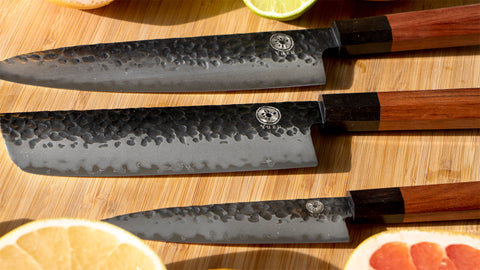
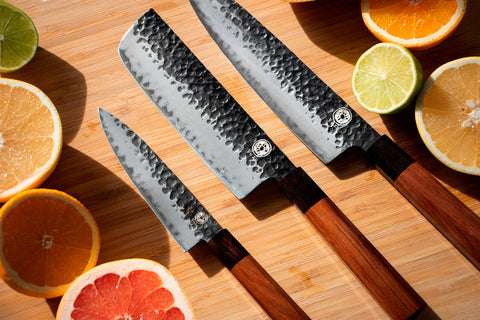
Easier to maintain than pure carbon steel, still cuts excellently. Yuzu knives use this construction - AUS-10 high carbon steel core with 430 stainless steel outer layers.
Common steel types
AUS-10: Japanese high-carbon steel rated 58-60 HRC. Balances hardness, edge retention, and sharpening ease. Stain-resistant but not fully stainless. This is what's in our gyuto core.
VG-10: Popular stainless steel at 59-61 HRC. Holds an edge and resists corrosion well. Some people find it harder to sharpen than AUS-10. See our head-to-head AUS-10 vs VG-10 comparison for the full breakdown.
Blue Paper Steel (Aogami): Traditional carbon steel, 63-65 HRC. Holds an edge exceptionally well but needs careful maintenance to avoid rust.
White Paper Steel (Shirogami): Pure carbon steel. Easier to sharpen than blue paper, same maintenance requirements.
How to care for your gyuto knife
Japanese knives need more attention than Western knives because of the harder steel and thinner blades.
Daily care
Hand wash right after use with mild soap and warm water. Don't put it in the dishwasher. The harsh detergents, heat, and rattling around will damage the edge and can crack the handle.
Dry the blade completely before you put it away. Even stainless steel can develop rust spots if you leave it wet. Carbon steel will rust fast.
Store it in a knife block, on a magnetic strip, or in a protective saya. Tossing it in a drawer will dull the edge and is asking for an accident.
Cutting surfaces
Use wood or soft plastic cutting boards. Glass, marble, ceramic, and bamboo are too hard. They'll dull your edge quickly and can chip the blade on harder gyutos.
Sharpening
Sharpen on whetstones, not pull-through or electric sharpeners. Those can damage the thin edge. A dual-sided whetstone with 1000 and 3000-6000 grit covers most home needs.
Keep the original edge angle when you sharpen - usually 15 degrees per side for Japanese knives. If you're new to whetstones, use an angle guide until you get the feel for it. Our step-by-step whetstone guide walks through the full process.
How often depends on how much you use it. Most home cooks sharpen every 2-4 weeks. Use a honing rod between sharpenings to straighten the edge.
Choosing your first gyuto knife
What to consider beyond price:
Blade length: Start with 210mm unless you have a specific reason to go different. Most versatile size.
Handle style: Traditional Japanese wa-handles (wood, octagonal) or Western yo-handles (contoured plastic or wood). Try both if you can - it's personal.
Steel type: For your first gyuto, get stainless or semi-stainless like AUS-10 or VG-10. More forgiving while you're learning proper care.
Weight and balance: Should feel balanced when you pinch grip it (thumb and forefinger on the blade just in front of the handle). Some people like blade-heavy for chopping, others want neutral balance for control.
Budget: Good gyutos start around £80-120. Mid-range (£120-250) works well for most people. Above £250, you're paying for premium materials, hand-forging, or artisan work.
Still deciding whether a gyuto is the right starting point? Our guide to choosing the best kitchen knife covers the broader decision.
How to use a gyuto knife
Coming from a Western knife, the adjustment is small. A few technique changes and you'll get more out of the blade.
The pinch grip
Pinch the blade just ahead of the handle between your thumb and the side of your index finger, with your remaining fingers wrapped around the handle. It shifts control from the handle to the blade itself. Feels odd for a day or two, then becomes automatic.
Push-cuts over rocking
Drive the blade down and slightly forward through the ingredient in one motion, rather than rocking. The whole edge contacts the board at once. Once it clicks, it's faster than rocking for most tasks.
The guide hand
Curl your fingers into a claw, knuckles forward, fingertips tucked back. The flat of the blade rides against your knuckles as a guide. Move your guide hand backward as you work through the ingredient, blade following.
What to avoid
No rocking, scraping, or using the blade as a scoop. The thin steel isn't built for lateral stress. Bones, frozen food, and hard seeds will chip it. The gyuto is precise because it's optimised for clean forward cuts. Use it for anything else and you're working against the design.
Conclusion
The gyuto is Japanese knife-making applied to an all-purpose kitchen blade. The thin profile, hard steel, and acute edge angle deliver performance Western knives can't match, especially for vegetables, fish, and boneless meats.
A 210mm gyuto is probably the most useful knife you'll own. Handles everything from breaking down a chicken to fine herb work. With proper care, it'll last decades.
Ready to try one? Our gyuto knife uses AUS-10 steel in san-mai construction. Or check out the starter kit with everything you need to get going and keep the blade sharp.