
Japanese Chef Knives: Why Professionals Choose Them
A Japanese chef knife carries centuries of sword-making tradition into the kitchen. These knives have earned their reputation among professional chefs worldwide through harder steel, sharper edges, and meticulous craftsmanship. Western knives simply can't match them.
If you're considering upgrading your kitchen tools or wondering what sets Japanese knives apart, this guide explains why they've become the standard in professional kitchens and why they might transform your home cooking too.
What makes Japanese chef knives different?
The fundamental difference lies in the steel itself. German knives typically have a Rockwell hardness around HRC 57. Japanese chef knives start at HRC 60 and often exceed HRC 62. This harder steel holds an edge significantly longer and achieves a level of sharpness that softer steel cannot maintain.
But hardness alone doesn't tell the whole story. Japanese knife makers have perfected the balance between hardness and toughness, making blades that stay incredibly sharp yet remain practical for daily kitchen use. Take AUS-10 steel, which sits at HRC 58-60. It offers excellent edge retention without becoming so brittle that it chips easily during normal food preparation.
The blade: thinner, sharper, more precise
Pick up a Japanese chef knife and the first thing you'll notice is its weight, or rather, the lack of it. Japanese blades run thinner and lighter than their Western counterparts, which creates several practical advantages.
The thinner blade profile (often around 2mm) slices through ingredients with less resistance. This means cleaner cuts through delicate items like tomatoes or fresh herbs, where a heavier knife would crush rather than slice. The reduced weight also means less hand fatigue during extended prep sessions, something professional chefs particularly appreciate.
Many Japanese knives feature a straighter edge profile compared to the curved belly of Western chef's knives. This design supports a different cutting technique: the push-cut or chop, where the blade moves straight down through ingredients rather than rocking back and forth. Once you adapt to this technique, it becomes efficient for processing vegetables.
Understanding Japanese knife types
When people refer to "Japanese chef knives," they're often talking about several different blade styles, each designed for specific tasks:
The gyuto: your all-purpose workhorse
The gyuto is the Japanese equivalent of a Western chef's knife, but with all the characteristics that make Japanese knives special. With a blade typically between 200-240mm, it handles most kitchen tasks: slicing proteins, chopping vegetables, fine mincing work.
The Yuzu Gyuto has a 205mm blade made from Japanese AUS-10 steel in San-Mai construction. At 250g, it's substantial enough to handle dense ingredients yet light enough for extended use without fatigue.
The nakiri: vegetable preparation specialist
The nakiri's distinctive rectangular blade and flat edge make it ideal for processing vegetables. The flat profile means the entire edge makes contact with the cutting board simultaneously, creating even slices in a single motion. The height of the blade also makes it useful for scooping up chopped ingredients and transferring them to your pan or bowl.
The petty: precision and detail work
Think of the petty as the Japanese paring knife, but better. These smaller knives (typically 120-150mm) excel at tasks requiring control: peeling, trimming, deveining, and other detail work where a larger blade would be cumbersome.
What knives do Japanese chefs actually use?
Walk into a professional kitchen in Tokyo or Osaka and you won't find a single knife doing every job. Japanese chefs build their knife rolls around specific tasks, and most carry between three and six blades depending on their speciality.
The gyuto sits at the centre of nearly every Japanese chef's kit. It handles the bulk of daily prep work: breaking down proteins, rough-chopping vegetables, mincing aromatics. Most professionals prefer a 210mm or 240mm blade, and they'll often own two in different lengths for different tasks.
For vegetable-heavy work, the nakiri is the go-to blade. Its flat edge and tall rectangular profile make quick work of high-volume vegetable prep. Chefs working in restaurants that serve salads, stir-fries, or traditional Japanese cuisine reach for a nakiri constantly.
The petty knife rounds out the daily essentials. Japanese chefs use it for everything the gyuto is too large for: trimming fat, peeling ginger, scoring fish skin, cleaning vegetables. It's the knife that stays within arm's reach at all times.
Beyond these three, specialist knives come into play depending on the kitchen. Deba knives handle breaking down whole fish—their thick, heavy single-bevel blades manage bones and cartilage that would damage thinner knives. The yanagiba, a long slender sashimi knife, allows chefs to slice raw fish in a single pulling motion for a clean, glossy surface. The usuba handles decorative cuts and paper-thin vegetable slicing in traditional Japanese restaurants.
Most Japanese chefs also carry a small pocket knife or utility blade for opening packages, cutting twine, and other non-food tasks that would damage a good kitchen knife.
The key takeaway: Japanese professionals don't rely on one knife for everything. They match the blade to the task. For home cooks, starting with a gyuto, nakiri, and petty covers about 95% of kitchen work.
Why are Japanese chef knives so expensive?
A quality Japanese chef knife costs more than a mass-produced Western knife. That's a fact. But the price reflects real differences in materials, process, and longevity.
It starts with the steel. High-grade Japanese knife steels like AUS-10, VG-10, and the various carbon steels cost significantly more than the softer stainless used in budget knives. These steels are produced in smaller quantities, require precise heat treatment, and demand more skill to work with during forging and grinding.
Then there's the production method. Many Japanese knives involve hand-forging steps, even in workshops that use some modern equipment. A skilled smith shapes the blade, controls the heat treatment, and grinds the geometry by hand. This is slower than stamping blades from sheet metal on an automated production line.
Fit and finish also adds cost. Proper handle fitting, blade polishing, edge sharpening to a fine grit, and final quality inspection all take time. A factory knife might get 30 seconds of finishing. A Japanese knife might get 30 minutes.
But here's the argument that matters most: cost per year of use. A quality Japanese chef knife lasts 20-30 years with basic maintenance. A cheap knife loses its edge within weeks, can't be resharpened effectively, and gets replaced every two to three years. Spend £40 on a knife five times over 15 years and you've spent £200 on tools that never performed well. Spend £120 once on a proper Japanese knife and you have 15 years of sharp, precise cutting behind you, with many more ahead.
Steel and construction: the heart of quality
The steel choice determines a knife's performance characteristics. High carbon steels like White Paper Steel and Blue Paper Steel achieve incredible hardness (up to HRC 65) and take an exceptionally keen edge, but they require careful maintenance and rust if not dried immediately after use.
For most users, including many professionals, stainless steels like VG-10 or AUS-10 offer a more practical solution — our detailed AUS-10 vs VG-10 comparison explains which suits different cooking styles. These steels maintain excellent hardness and edge retention while providing significantly better corrosion resistance. They don't require the same obsessive care, making them suitable for busy kitchen environments.
San-Mai construction takes this concept further by combining the best of both approaches. This three-layer construction places a hard steel core (for the cutting edge) between two layers of softer, more corrosion-resistant steel (for protection). The result is a blade that performs like carbon steel but behaves like stainless.
Why professionals choose Japanese knives
Walk into any high-end restaurant kitchen and you'll see Japanese knives everywhere. This isn't fashion or tradition. It's pragmatism. Professional cooks make thousands of cuts during a service, and Japanese knives provide tangible benefits:
Edge retention means less frequent sharpening. A sharp knife is safer and more efficient than a dull one. When your knife holds its edge through an entire service without requiring touch-up, that's fewer interruptions to your workflow.
Lighter weight reduces fatigue. Prep work often involves repetitive cutting for extended periods. The reduced weight of Japanese knives means less strain on your wrist and forearm over the course of a shift.
Precision cuts improve presentation and consistency. The sharper edge and thinner blade allow for more controlled cuts, which matters both for visual appeal and for ensuring ingredients cook evenly.
The right tool for the job improves results. Having specialized knives (a gyuto for proteins, a nakiri for vegetables, a petty for detail work) means using a tool optimized for each task rather than compromising with a single all-purpose blade.
Are Japanese knives right for you?
Japanese chef knives are a significant step up from typical kitchen knives, but they do require a shift in both technique and maintenance habits.
These knives work best for cooks who:
- Value precision and enjoy the process of cooking, not just the end result
- Are willing to learn proper cutting techniques and knife maintenance
- Prepare fresh ingredients regularly rather than relying primarily on pre-processed foods
- Want tools that will last years or even decades with proper care
If you're still using knives that came with your kitchen or were purchased as an afterthought, upgrading to a proper Japanese chef knife will noticeably improve your cooking experience. The difference in how a truly sharp knife glides through ingredients (rather than crushing or tearing) has to be experienced to be fully appreciated.
How to find the best Japanese chef knife
Plenty of knives call themselves "Japanese." The label alone means nothing. What separates a good Japanese chef knife from a forgettable one comes down to a few measurable things.
Start with the steel. Look for a Rockwell hardness of HRC 58 or above. Below that and you're in Western-knife territory where the edge dulls after a few days of regular use. The sweet spot for most cooks is HRC 58-61: hard enough to hold an edge for weeks, tough enough that you're not worrying about chips. AUS-10 and VG-10 both sit in this range. Avoid knives that don't list their steel grade at all. If the manufacturer won't tell you what's in the blade, that tells you enough.
Blade thickness matters more than most buyers realise. Under 2mm at the spine is what you want for a chef knife. Thicker blades need more downward force, wedge through dense ingredients instead of slicing, and feel clumsy on anything delicate.
Check where the blade meets the handle. Gaps or visible adhesive mean poor assembly. The tang should sit flush and feel solid when you grip the knife. Handle material affects comfort over long sessions. Real wood like ebony, sandalwood, or magnolia is lighter and warmer in the hand than plastic composites. Traditional wa handles with an octagonal cross-section stop the knife from rotating during use. It's a small thing, but you notice it once you've cooked with one.
For balance, hold the knife in a pinch grip and let it rest. It should sit level where your thumb and forefinger meet the blade, not tipping forward or back. A blade-heavy knife tires your wrist. A handle-heavy one feels disconnected from the cutting edge.
Price gives you a rough signal. Between £80 and £150 you'll find properly made knives with good steel and decent fit and finish. Below £50, the steel is almost always too soft to hold a useful edge. Above £200, you're usually paying for a maker's name or decorative finishing rather than better cutting performance.
Best Japanese knife for everyday cooking
If you're buying one knife, make it a gyuto in the 200-210mm range. It handles proteins and vegetables equally well, without specialising too much. At this length it fits on a standard home cutting board and works for everything from breaking down a chicken thigh to dicing shallots.
A starter kit that includes the knife, a whetstone, and a saya is a practical first purchase. You'll need sharpening tools anyway, and buying them separately usually costs more. Skip the temptation to buy a full knife set on day one. Start with a single gyuto, cook with it for a month, and you'll know exactly which specialist knives you actually want next.
Caring for your Japanese chef knife
Japanese knives require more care than mass-produced Western knives, but the maintenance routine becomes second nature quickly:
Hand wash and dry immediately after use. Never put Japanese knives in the dishwasher. The harsh detergents and extreme heat will damage both the blade and handle. Wash with mild soap and water, then dry thoroughly with a towel.
Use appropriate cutting surfaces. Wood or soft plastic cutting boards are ideal. Avoid glass, marble, or ceramic boards, which will quickly dull even the hardest steel and may cause chipping.
Store knives properly. Wooden sayas (blade covers) provide excellent protection and look beautiful. Magnetic strips work well too, but avoid knife blocks where blades rub against wood with every insertion and removal.
Sharpen regularly with a whetstone. This is the primary maintenance requirement that intimidates people, but whetstone sharpening is a learnable skill. A dual-sided whetstone with medium (1000 grit) and fine (3000-6000 grit) sides will handle all your sharpening needs.
Most home cooks need to sharpen their knives every few months with regular use. Professional kitchens may sharpen weekly or even daily, depending on volume. The actual sharpening process takes 10-15 minutes once you're comfortable with the technique.
The investment perspective
Quality Japanese chef knives sit in a price range that seems expensive compared to supermarket knife sets but offers exceptional value over their lifespan. A well-made Japanese knife will easily last 20-30 years with proper care and maintenance, potentially outlasting your current kitchen.
Compare this to replacing cheaper knives every few years when they become irreparably dull or damaged, and the economics become clear. You're not just buying a tool. You're investing in equipment that improves your daily cooking experience for decades.
The complete Yuzu knife set includes a gyuto, nakiri, petty, and bread knife crafted with Japanese steel, covering essentially every cutting task in a home kitchen. This is likely the last knife set you'll need to buy, assuming reasonable care.
The Yuzu range: Japanese chef knives for everyday use
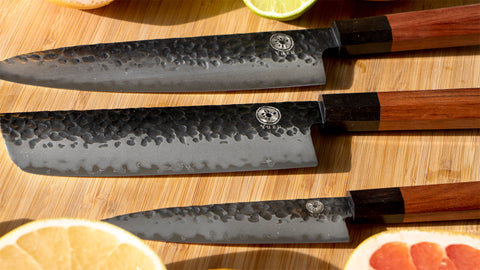
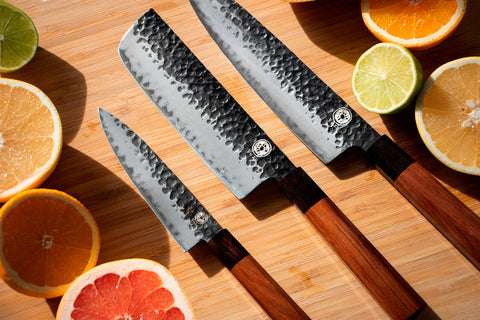
Every Yuzu knife uses AUS-10 high-carbon steel in san-mai construction, with a kurouchi finish and an ebony and sandalwood wa handle. Here's where to start:
- Gyuto (205mm): The all-purpose knife for 80% of kitchen tasks. Start here if you're building your first Japanese knife kit. £109.
- Nakiri: Dedicated vegetable knife. Flat blade, clean push-cuts, no rocking. Useful if vegetables make up a big part of your cooking. £109.
- Petty: For detail work: peeling, trimming, scoring. Handles what the gyuto is too large for. £75.
- Four Knife Set (Gyuto, Nakiri, Petty, Bread Knife): All four knives at a better price than buying separately.
The Gyuto Starter Kit includes a whetstone and saya with the knife, which makes sense as a starting point if you don't have sharpening tools.
Making the switch to Japanese knives
The transition from Western-style knives to Japanese blades involves a learning curve, but it's shorter than most people expect. The different cutting techniques (push-cutting rather than rocking, using the flat edge of a nakiri for vegetables) feel natural after just a few cooking sessions.
The maintenance requirements also become routine quickly. After a few weeks, the habit of hand washing and immediately drying your knife happens automatically. Learning to sharpen on a whetstone takes a few practice sessions, but once you can maintain your own edges, you're no longer dependent on professional sharpening services.
What you gain in return is a set of tools that performs noticeably better than typical kitchen knives. Ingredients cut cleanly rather than being crushed. Prep work becomes faster and more enjoyable. The quality of your knife work improves, which positively impacts both the cooking process and final presentation.
Start your Japanese knife journey
Japanese chef knives bring centuries-old sword-making techniques into modern kitchen tools. The same methods that created samurai swords now produce knives that simply work better than mass-produced alternatives.
For professional chefs, these knives are essential equipment. For home cooks who care about their tools and enjoy the cooking process, they're an investment that pays off in daily use for years to come.
Ready to experience the difference? Start with a quality gyuto chef's knife crafted with Japanese steel and the tools needed to maintain it. Once you've cooked with a properly sharp Japanese knife, your old knives will feel dull by comparison, and you'll understand exactly why professionals make this choice.