
The Petty Knife: Your Precision Kitchen Companion
A petty knife is a small, versatile Japanese utility knife with a blade length between 120-150mm (roughly 4-6 inches). It sits somewhere between a paring knife and a chef's knife, offering precision for delicate tasks while still having enough blade to handle small slicing jobs. The name comes from the French word "petite," meaning small.
Think of it this way: when your gyuto feels too large and your paring knife feels too small, reach for a petty. It's the knife professional chefs grab dozens of times a day without thinking about it.
What Makes a Petty Knife Different?
The petty knife arrived in Japan during the Meiji Era (late 1800s) when Japanese culture opened up to Western influences. Japanese knife makers adapted the Western utility knife concept, creating something that balanced Western versatility with Japanese precision and sharpness.
Quick Comparison
A petty knife is more precise than a utility knife and longer than a paring knife. Japanese petty knives also have a flatter blade profile and sharper tip compared to curved Western paring knives. More on that below.
How does a petty knife compare to a paring knife?
People mix these two up all the time. A petty knife is longer (120-150mm vs 75-100mm for a paring knife), uses harder steel, and works on a cutting board as well as in your hand. A paring knife is really just for peeling and trimming. Our Japanese paring knife guide covers the full comparison if you're deciding between the two.
What Is a Petty Knife Used For?
The petty knife handles any task where precision matters more than power. Here's where it shines:
Fruits and Vegetables
Use your petty for peeling apples, potatoes, carrots, and citrus fruits. The sharp tip slips just under the skin, removing only a thin layer and reducing waste. It's also perfect for:
- Trimming and cleaning mushrooms
- Deseeding peppers and removing stems
- Coring tomatoes
- Making decorative cuts and garnishes
- Segmenting citrus fruits
Meat and Protein Prep
The slim, nimble blade gets close to meat without tearing:
- Trimming fat and sinew from chicken, pork, or beef
- Removing silver skin from tenderloin
- Deveining shrimp
- Tidying up fish fillets
- Breaking down small proteins on a cutting board
Herbs and Aromatics
On a small cutting board, the petty knife gives you control for fine work:
- Slicing garlic paper-thin
- Mincing shallots and chili peppers
- Chiffonading basil
- Brunoise cuts (tiny, uniform dice)
- Cutting chives into neat, even pieces
When Not to Use a Petty Knife
Every knife has its limits. Don't reach for your petty when:
- Cutting hard vegetables like squash or root vegetables (use a gyuto or nakiri)
- Slicing large quantities (your chef's knife is more efficient)
- Breaking down whole chickens or large cuts of meat
- Cutting through bones
How to Choose a Quality Petty Knife
Blade Length
Petty knives typically range from 120mm to 150mm (roughly 4.7 to 6 inches). For most home cooks, a 120-135mm blade offers the best balance between precision and versatility.
Steel Type
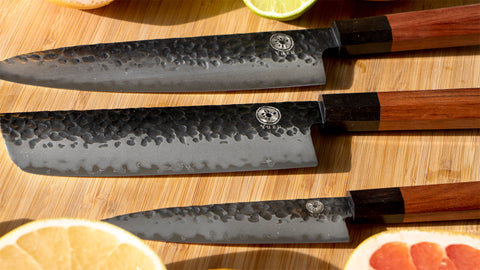
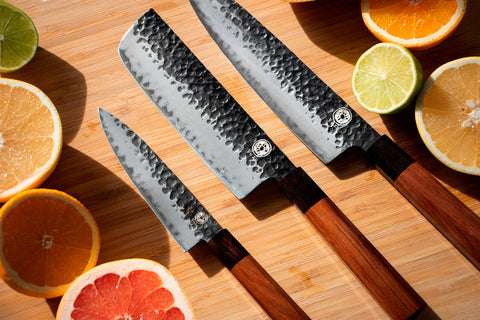
Japanese petty knives are made from either carbon steel or stainless steel. Carbon steel takes an incredibly sharp edge but requires more maintenance to prevent rust. High-carbon stainless (like Yuzu's AUS-10 steel with san-mai construction) combines edge retention with easier care.
For a knife you'll use daily, high-carbon stainless makes sense. You get sharpness without the fuss.
Handle Style
Traditional Japanese wa handles (typically octagonal) offer excellent control for precision work. The lighter weight and smaller diameter suit detailed tasks better than bulkier Western handles.
Weight and Balance
Pick up the knife if possible. A well-balanced petty should feel like an extension of your hand, not front-heavy or awkward. The Yuzu petty knife weighs around 100-120g, which gives you control without fatigue.
Caring for Your Petty Knife
The same care rules that apply to your chef's knife apply here:
Daily Maintenance
Never put Japanese knives in the dishwasher. Hand wash and dry them immediately after use. Use wood or soft plastic cutting boards, never glass or stone which will dull the edge. Store your petty in a wooden saya (sheath) or on a magnetic knife strip.
Sharpening
Japanese petty knives are typically sharpened to a 15-degree angle on each side (compared to 20 degrees for Western knives). Use a dual-sided whetstone to maintain that edge. The smaller blade makes sharpening faster than your larger knives.
How often? Depends on use, but most home cooks should sharpen every 2-3 months with regular honing in between.
Is a Petty Knife Worth It?
If you already own a gyuto or chef's knife, a petty is the next knife to add.
Small tasks go faster with the right-sized tool. Mincing garlic with an 8-inch chef's knife is like using a sledgehammer to crack a walnut. The shorter blade also gives you better control for detailed work - you see exactly where the tip is going.
It fills the gap between your paring knife (if you have one) and your main chef's knife. Most professional kitchens have multiple petty knives in rotation.
For the price, few knives offer this level of everyday utility. The Yuzu petty is £75 on its own, or you can get it as part of the three-knife set with a gyuto and nakiri.
The Bottom Line
The petty knife is the most underrated knife in the kitchen. It doesn't get the attention of a chef's knife or the specialty appeal of a nakiri, but professional cooks reach for it constantly. Once you have one, you'll wonder how you managed without it.
Look for a blade around 120-135mm in high-carbon stainless steel with a comfortable handle. Take care of it like your other good knives. And give it a few weeks to become part of your routine. You'll find yourself using it more than you expected.
Ready to add precision to your knife collection? Check out the Yuzu petty knife, hand-forged in Japan with AUS-10 steel and traditional craftsmanship. Or explore the complete knife set to build a well-rounded kitchen arsenal.