
Knife Sharpening Angle Guide: How to Find the Right Angle for Your Knife
The sharpening angle you use determines how sharp your knife gets and how long that edge lasts. Get it wrong and you either chip a thin edge through hard use or waste time grinding a thick one that never feels sharp.
Most kitchen knives fall between 15 and 22 degrees per side. Japanese knives sit at the lower end (sharper, more delicate), Western knives at the higher end (tougher, more forgiving). The right angle depends on the knife, and holding it consistently is the real skill.
Quick reference: sharpening angles by knife type
| Knife type | Angle per side | Inclusive angle | Notes |
|---|---|---|---|
| Japanese double-bevel kitchen knives | 10-15 degrees | 20-30 degrees | Gyuto, nakiri, petty, santoku |
| Japanese single-bevel knives | 5-8 degrees (one side) | 5-8 degrees | Yanagiba, deba, usuba |
| Western kitchen knives | 17-22 degrees | 34-44 degrees | Most European brands default to 20 |
| Fillet knives | 15-16 degrees | 30-32 degrees | Thin, flexible blades need a lower angle |
| Pocket and EDC knives | 18-20 degrees | 36-40 degrees | Balance of sharpness and durability |
| Hunting and outdoor knives | 20-25 degrees | 40-50 degrees | Tougher edge for rough tasks |
| Cleavers and axes | 25-30+ degrees | 50-60+ degrees | Durability over sharpness |
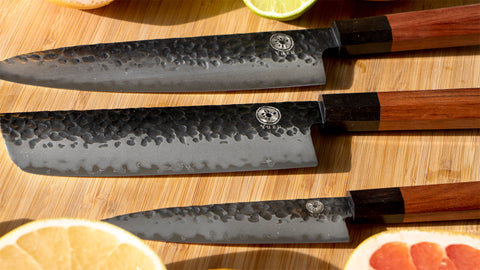
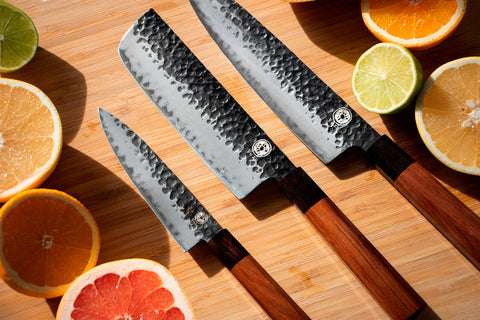
If you are sharpening a Yuzu Gyuto, Nakiri, Petty, or Bread Knife, they come sharpened at 15 degrees per side. Stick to that angle when maintaining them.
What does "sharpening angle" actually mean?
The sharpening angle is the angle between the blade and the surface of your sharpening stone, measured on one side. This is called "degrees per side" or DPS.
When someone says a knife is sharpened to 15 degrees, they mean 15 degrees on each side. The total angle where both sides meet (the "inclusive angle") is 30 degrees. This distinction trips people up constantly, so pay attention to whether a recommendation says "per side" or "inclusive."
A lower angle produces a thinner, sharper edge. A higher angle produces a thicker, tougher edge. That is the basic tradeoff, and everything else follows from it.
Japanese kitchen knives: 10-15 degrees
Japanese kitchen knives use harder steel (typically HRC 58-67) which can hold a thinner edge without rolling or chipping. This lets you sharpen at 10-15 degrees per side and get a razor-like cutting edge.
Most Japanese double-bevel knives (gyuto, nakiri, santoku, petty) work well at 15 degrees per side. That is the factory angle on Yuzu knives and the sweet spot for AUS-10 steel at HRC 58-60. It gives you a noticeably sharper edge than a Western knife while being tough enough for daily kitchen use.
Traditional single-bevel Japanese knives (yanagiba, deba, usuba) are a different story. These are sharpened on one side only, at 5-8 degrees. The other side is left flat or near-flat. Single-bevel knives are specialist tools for sushi preparation and professional Japanese cuisine, and sharpening them requires more skill.
The 70/30 edge
Some Japanese knives use an asymmetric grind, often called a 70/30 edge. The dominant side (typically the right) is sharpened at around 20 degrees, while the other side is sharpened at about 10 degrees. This gives an inclusive angle of roughly 30 degrees but with an asymmetric cutting profile that can improve food release and precision slicing.
If your knife came with a 70/30 edge, maintain it that way. Switching to a symmetric grind changes how the knife cuts.
Western kitchen knives: 17-22 degrees
Western kitchen knives use softer steel (HRC 54-58) which needs a wider angle to avoid edge damage. The standard is 20 degrees per side, giving a 40-degree inclusive angle.
Some brands have moved to lower angles in recent years. Wusthof now recommends 14 degrees per side for many of their knives. Zwilling recommends around 15 degrees. If you bought a recent European knife, check the manufacturer's recommendation before defaulting to 20.
That said, 20 degrees per side remains a safe and effective angle for any Western kitchen knife. If you are unsure, start there.
How to find your knife's current angle
Before sharpening, it helps to know what angle your knife is already at. Changing the angle means removing more steel, which is unnecessary if the factory angle works well.
The marker test
This is the simplest method. Colour the edge bevel with a permanent marker (a Sharpie works well). Make a few light passes on your whetstone. Look at the ink:
- If all the ink is removed evenly from the bevel, you are matching the existing angle
- If ink remains near the edge, your angle is too high (you are only hitting the shoulder)
- If ink remains near the spine, your angle is too low (you are only hitting the edge)
Adjust until the ink removes cleanly across the entire bevel. That is your knife's current angle.
The coin stack method
Stack coins under the spine of the knife as it rests on a flat surface. The height of the coin stack relative to the blade width gives you an approximate angle. Two stacked pound coins under the spine of a 50mm-wide blade puts you at roughly 15 degrees. It is not precise, but it gets you in the right range.
Sharpness vs durability: the tradeoff
Every sharpening angle is a compromise between cutting performance and edge longevity.
Harder steel supports lower angles. A knife with HRC 60+ can hold a 12-degree edge because the steel is hard enough to resist deformation. A knife at HRC 54 would chip or roll at that angle within minutes of use. This is why Japanese knives (hard steel) can be sharper than Western knives (softer steel) and stay that way.
What you cut matters. If you mostly slice vegetables, fish, and boneless meat, a 15-degree edge is ideal. If you regularly cut through chicken joints, hard squash, or frozen items, a 20-degree edge handles the abuse better. Match the angle to the work, not to some ideal number.
Lower is not always better. A 10-degree edge on a kitchen knife is extremely sharp but fragile. For most home cooks, 15 degrees on Japanese knives and 20 degrees on Western knives is the practical sweet spot. You get excellent sharpness without constant maintenance.
How to hold a consistent angle
Knowing the right angle is half the battle. Holding it consistently across the full length of the blade is the other half.
Use an angle guide (beginners)
Clip-on angle guides attach to the spine of the knife and rest on the stone surface, forcing a consistent angle. They are not precise enough for single-degree accuracy, but they keep you in the right range while you develop muscle memory. Remove the guide once you can feel the angle.
Lock your wrist (freehand)
The most common mistake in freehand sharpening is moving your wrist as you stroke. Your wrist angle sets the sharpening angle. Lock it. Move the knife with your arm and shoulder, keeping your wrist fixed. Lifting your elbow even slightly during a stroke changes the angle and rounds the edge.
Pressure and consistency
Use light, even pressure. Heavy pressure does not sharpen faster; it just gouges the stone unevenly and makes it harder to maintain your angle. Let the abrasive do the work. If you are pressing hard, you probably need a coarser grit, not more force.
Our whetstone guide walks through the full sharpening process step by step, including technique for knives such as the gyuto.
Can you change the factory angle?
Yes, but think about whether you should. Changing from 20 degrees to 15 degrees means removing steel from the entire bevel, not just the edge. The first sharpening at the new angle takes significantly longer and removes more material.
If your knife's steel can support a lower angle (check the HRC rating), it can be worth doing. If you bought a cheap Western knife at HRC 54-56 and try to put a 12-degree Japanese edge on it, the edge will roll within a few uses. Match the angle to the steel.
For Yuzu knives in AUS-10 steel (HRC 58-60), the factory 15-degree angle is already optimised. You would not gain much by going lower, and you would lose durability.
Micro-bevels: a useful shortcut
A micro-bevel is a tiny secondary bevel right at the cutting edge, typically 1-3 degrees steeper than your main bevel. You create it with a few light strokes at a slightly higher angle on a fine stone after finishing your normal sharpening.
The result: a main bevel ground at 15 degrees for slicing performance, with a micro-bevel at 17-18 degrees right at the edge for durability. You get most of the sharpness of a low angle with better edge retention. Japanese knife makers call this technique "itoba" and it is common practice in professional kitchens.
Micro-bevels are also fast to touch up. Instead of regrinding the full bevel, you can refresh just the micro-bevel in a few strokes. This extends the time between full sharpenings.
The bottom line
For most people sharpening kitchen knives at home, the answer is simple: 15 degrees per side for Japanese knives, 20 degrees for Western knives. Use the marker test to match your existing angle before you start, keep your wrist locked, and use light pressure.
If you are sharpening Yuzu knives, 15 degrees is the angle to maintain. Pair that with a dual-sided whetstone (start on the coarse side, finish on the fine side) and you can keep your knives performing like new for years.