
Gifts for Bakers: What Bread and Sourdough Bakers Actually Use
The best gifts for bakers who make bread are the tools they reach for every bake: a properly sharp bread knife, a banneton, a lame for scoring, good flour. If you only buy one thing, make it the knife. A sourdough baker spends a day or two getting a loaf right, and a blunt serrated blade can flatten the crumb in seconds.
This guide is written for bread and sourdough bakers rather than cake decorators. We make Japanese kitchen knives, so we'll be upfront that the bread knife is the part we know best. The rest of the list is the kit home bread bakers use week in, week out.
What Do You Buy a Baker Who Has Everything?
You buy them a better version of something they use constantly. Most keen bakers already own the basics, and they've often bought the cheapest option to get started. The supermarket bread knife and the plastic proofing bowl both work. They're also the first things most bakers would replace if they were spending on themselves.
A quick way to find the gap is to watch how they finish a loaf. If they wince when they cut into it, struggle with a crust, or hand you a slice that's been squashed at the top, the knife is the gift. If they're still proving dough in a tea-towel-lined bowl, a banneton will be used every week.
The other safe bet is something consumable they wouldn't normally treat themselves to, like a bag of stoneground or heritage flour from a small mill. It gets used up, so it never ends up in the back of a cupboard.
Why Is a Bread Knife the Best Gift for Sourdough Bakers?
Because sourdough is the hardest bread to slice well. The crust is thick and blistered from a hot, steamy bake, and the crumb inside is open, soft and a bit moist. A dull knife can't bite into that crust, so you press down harder, and the pressure squashes the crumb underneath before the blade gets through. You end up with a squashed slice and half the loaf in crumbs on the board.
Serrations solve the first half of the problem. The teeth catch the crust straight away, so you can saw through with very little downward force. Our guide to the Japanese bread knife goes into why the shape and spacing of the teeth matter, and why finer serrations tear less than deep, pointed ones.
The second half is the steel. Cheap bread knives cut well for a few months, then the teeth round off and the knife starts tearing instead of slicing. Harder steel keeps those teeth sharp for much longer. For a baker who slices a loaf most days, that's the difference between a knife they put up with and one they actually like using.
One thing worth passing on with the gift: no knife can save a hot loaf. Sourdough needs a couple of hours on the rack before you cut it, because the inside is still full of moisture and the starch hasn't set. Cut it too early and even a sharp knife will leave a gummy, sticky crumb.
The Yuzu Bread Knife
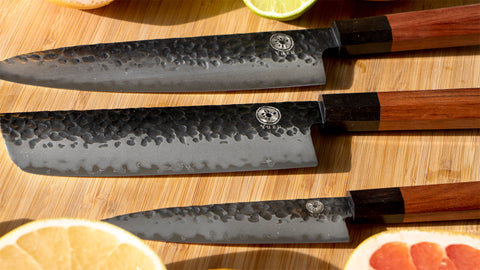
The Yuzu Bread Knife was made for exactly this job. It cuts through a crusty sourdough without crushing the crumb, and it handles roast meat and tomatoes just as well, anything with a tough outside and a soft inside.
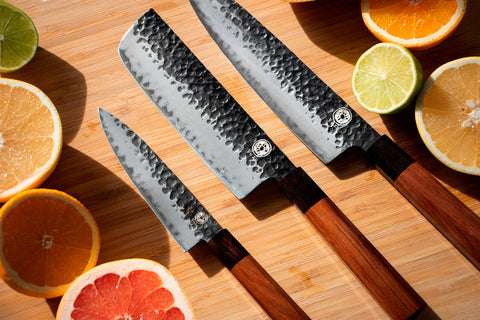
The core is AUS-10 steel from Tokai, Japan, wrapped in two layers of protective stainless steel (San-Mai construction). It's rated HRC 58-60, so the serrations hold their edge far longer than a straight blade would. The blade is hand-forged with a Kurouchi blacksmith's finish, which helps food release and protects the steel against rust. The Wa handle is ebony and rosewood, light, well balanced and comfortable to hold through a long sawing stroke.
If you want to know why we chose AUS-10 over harder steels, our piece on Japanese knife steel explains the trade-off. In short, it's hard enough to stay sharp and tough enough not to chip.
Add a Wooden Saya
A bread knife usually lives in a drawer, and drawers are where serrations get knocked about. The wooden saya for the bread knife is a sheath made to fit the blade, with a small magnet that holds the cover in place. It keeps the edge protected in a drawer or in a bag on the way to a picnic. Wrapped up with the knife, it makes the present feel complete. Here's more on what a saya is and why it's worth using.
Other Gifts Bread Bakers Use Every Week
These are the tools that come up again and again when sourdough bakers talk about their kit. None of them need to be fancy. They need to be sturdy and the right size.
- Banneton (proofing basket): Holds the dough's shape during the final proof so it doesn't spread flat. Cane bannetons leave the classic spiral of flour on the crust. Check whether they bake round boules or oval bâtards before you choose a shape.
- Bread lame: A razor blade on a handle, used to score the dough just before it goes in the oven. A clean, confident score controls where the loaf opens up. A blunt kitchen knife drags and tears the dough instead.
- Cast iron pot or Dutch oven: Baking the loaf under a lid traps the steam coming off the dough, which keeps the crust soft long enough for the bread to rise fully. Lift the lid for the second half and the crust browns and crackles.
- Digital scale: Bread recipes work in grams and percentages, and a scale that reads to the gram makes them repeatable. A second, smaller scale for salt and starter is a nice touch for a serious baker.
- Dough scraper: A flexible plastic one for getting dough out of the bowl and a stiff metal bench scraper for dividing and shaping. They're cheap, and they get used on every bake.
- Probe thermometer: Useful for checking water temperature and whether a loaf is baked through. Bakers often use it to check the loaf has cooled enough to slice, too.
- Good flour: A strong bread flour, some wholemeal or rye, or a bag from a local mill. Most bakers would happily try a flour they haven't baked with before.
- Linen bread bag or proofing cloth: For storing the finished loaf or for proving baguettes. Linen lets the crust breathe, so it stays crisper than it would in plastic, though the crumb dries out a little faster.
The knife is the one item on this list a baker uses on every loaf, after all the other work is done.
Gifts for Bakers Who Also Cook
Plenty of bread bakers are just as keen in the rest of the kitchen. Someone who makes their own focaccia is probably slicing the onions and rosemary for it, too. For them, a small sharp knife for prep makes a good second present.
The Yuzu Petty Knife is a short utility blade for jobs that need a steady hand: slicing strawberries for a tart, trimming herbs, peeling ginger. It shares the bread knife's AUS-10 core, Kurouchi finish and ebony and rosewood handle, so the two look like a pair on the board. Our guide to the petty knife covers what it does best.
If you want to go further, the bread knife also comes as part of the Four Knife Set, alongside the Gyuto, Nakiri and Petty. That covers a home kitchen from the morning loaf to the evening meal.
What Should You Avoid Buying a Baker?
Avoid anything that duplicates kit they already use and like, and avoid single-purpose gadgets. Bakers tend to be particular about their setup, and a second banneton in the wrong size, or a loaf-slicing guide they never asked for, usually goes straight into a cupboard.
Be careful with cake-focused gifts, too. Piping sets, turntables and novelty cake tins are great for a cake baker but of little use to someone whose week revolves around a sourdough starter. If you're not sure which kind of baker they are, ask what they made last weekend.
Finally, don't buy a cheap bread knife as a stocking filler. It's the tool that does the most visible damage when it's dull, and a budget one will be dull within the year.
Not Sure What They Need?
If you can't tell what's already in their kitchen, a Yuzu Knives gift card lets them pick the knife they want. It's digital and arrives by email, which helps if you've left it late.
For ideas across the whole range and delivery dates for Christmas, see our gift guide.
The Short Version
The best gifts for bread and sourdough bakers are tools they use on every bake. A banneton, a lame, a heavy pot, a scale and good flour all earn their place. But the gift that makes the most difference is a bread knife that gets through a thick crust without crushing the crumb. Add a saya to protect the teeth, and it'll slice cleanly for years.