
Japanese Gifts: Meaningful Ideas Rooted in Japanese Craft
The best Japanese gifts are useful things made with care: a kitchen knife, a pocket knife with a long history, a tea bowl, a cloth to wrap it all in. They suit anyone who loves Japanese food, design or craft, and they get better the more they're used.
We make Japanese kitchen knives, so that's where most of this guide sits. But we've also included a few traditional Japanese gifts from outside the kitchen, plus some notes on how gift giving works in Japan, because it changes how you think about what to give.
What makes a good Japanese gift?
In Japan, gifts follow the calendar. There are two big seasonal gift moments: ochugen in midsummer and oseibo at the end of the year. Both are a way of thanking people who've helped you, like a boss, a teacher or an older relative. Both customs go back to the Edo period, and the traditional presents are usually practical: tea, coffee, seasonal fruit, cooking oil, sweets.
Two things from that tradition are worth borrowing for any gift list. First, useful beats decorative: a good Japanese gift gets used, so something for the kitchen or the table is a safe bet. Second, the wrapping counts. A plain box tied neatly, or a fabric wrap, shows you took your time.
Most of the ideas below follow from those two rules.
Japanese kitchen knives: a gift they'll use every day
For anyone who cooks, a Japanese kitchen knife is about as meaningful as Japanese cooking gifts get. It's in their hand most evenings, and a good one lasts for years.
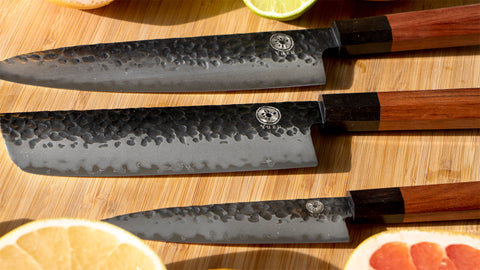
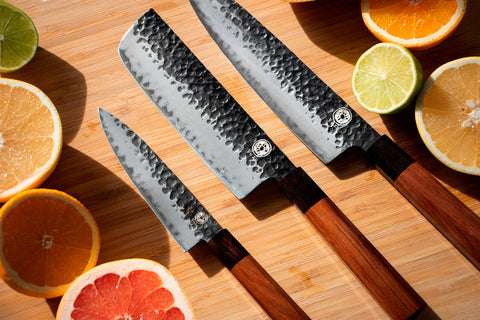
Our knives are hand-forged from AUS-10 steel from Tokai, Japan, in a three-layer San-Mai construction: a hard AUS-10 core for the edge, with stainless steel either side to protect it. Every blade has a Kurouchi finish, the dark, textured surface left from hammering the blade into shape. It helps food release from the blade and protects the steel from rust. If you want the full story, our article on how Japanese steel knives are forged covers it.
The handles are traditional Japanese Wa handles in ebony and rosewood, light and balanced to the blade. It's an old way of making a knife, built for cooking dinner on a Tuesday.
Which knife should you choose?
- For most cooks: the Gyuto, an all-purpose chef's knife for slicing meat, mincing herbs and dicing onions. If you only buy one, buy this.
- For someone who cooks a lot of veg: the Nakiri, a wide, flat vegetable knife built for a straight up-and-down chop through onions, carrots and butternut squash.
- For the detail person: the Petty, a small utility knife for peeling ginger, trimming fat and slicing strawberries.
Gifts that come ready to go
If the person is new to Japanese knives, the Gyuto Starter Kit is the easy choice. It pairs the knife with a wooden saya to protect the blade and a dual-sided whetstone to keep it sharp, so they have everything from day one. There are Nakiri and Petty versions too.
For a bigger present, the Three Knife Set brings the Gyuto, Nakiri and Petty together. That's one knife for general cooking, one for veg and one for the fiddly jobs.
What is a Higonokami, and why does it make a good gift?
The Higonokami is a traditional Japanese folding pocket knife. It has no lock and no spring. Friction in the pivot holds the blade open, and a small lever on the spine, the chikiri, gives your thumb something to press on as you cut. The handle is a simple folded sheet of metal.
The design comes from Miki, in Hyōgo Prefecture, and is usually dated to 1896 (some sources date it a few years earlier). It took off in the years after the Meiji reforms, when sword demand collapsed and smiths turned to everyday tools. Sales fell after Japan tightened its knife laws in 1961, but the design never really went away. Our article on the Higonokami's history goes into more detail.
Our Higonokami follows that traditional friction-folder design, with a stainless steel blade that handles cardboard, rope, fabric, leather and wood. It folds down to 9cm and comes with a leather sleeve. It's a small, personal thing to give and a classic among Japanese gifts for him, though anyone who opens parcels, peels fruit on a walk or whittles at the weekend will get use from it.
Gifts for someone who already owns a Japanese knife
If they already have a good knife, help them look after it. These are the gifts people don't buy for themselves.
A wooden saya
A saya is a wooden sheath shaped to the blade. It keeps the edge safe in a drawer or a knife roll and makes the knife easy to carry to a friend's house. Ours each hold the cover in place with a small magnet. There's a saya for the Gyuto, one for each of our other knives, and bundles that cover a full set. They're made to fit Yuzu knives, so check what they own first. Our guide to what a saya is and why to use one has more.
A whetstone
Japanese knives are meant to be sharpened on a stone, not dragged through a pull-through sharpener. Our Dual-Sided Whetstone has a 1000 grit side to bring back a dull edge and a 3000 grit side to polish it, and it sits in a wooden base that holds it still. Pair it with our step-by-step whetstone guide and they'll have a new skill as well as a new tool.
Traditional Japanese gifts beyond the kitchen
Japanese craft goes well beyond knives. A few traditional Japanese gifts that sit nicely alongside a knife, or work on their own:
Tea ware
For a matcha drinker, the classic trio is a chawan (tea bowl), a chasen (bamboo whisk) and a chashaku (bamboo scoop). Whisks are sold by their rough number of prongs, often 80 to 120. More prongs make more foam, but that doesn't mean a better whisk. Some schools of tea ceremony don't want much froth at all.
Ceramics
Hand-thrown bowls, small plates and chopstick rests are good Japanese inspired gifts for someone who cares about how food looks on the table. Each piece is slightly different, which is half the appeal.
Furoshiki
A furoshiki is a square of cloth used to wrap and carry things. The name joins furo (bath) and shiki (to spread). The usual story is that it began as a cloth for bundling clothes at the bathhouse, then spread to everyday life in the Edo period as public bathhouses became common, when people started using it for food, books and gifts. Wrap a knife box or a whetstone in one and the wrapping becomes part of the present. Our knives come in a handsome box of their own, ready to present as a gift. It won't end up in the bin either.
Japanese gifts for him (and everyone else)
If you're stuck, match the gift to the person rather than the occasion:
- A keen home cook: a Gyuto, or the Gyuto Starter Kit if they're new to Japanese knives.
- Someone who's always outdoors or fixing things: the Higonokami.
- Someone who already has a good knife: a saya or a whetstone.
- A tea drinker: a chawan and chasen, wrapped in furoshiki.
- The person you can never buy for: a Yuzu Knives Gift Card, delivered by email, so they can pick the knife they want.
A few practical notes for Japanese Christmas gifts
In many places knives are sold to adults only, so an adult may need to take in the delivery. If it's a surprise, have it sent to your own address and wrap it at home. If you're cutting it close to the big day, the gift card arrives by email and never misses a date. For delivery cut-offs and more ideas by budget, see our gift guide.
Choosing a Japanese gift that lasts
The Japanese gifts people remember are the ones they use. A knife that's on the board most evenings. A pocket knife that lives in a coat pocket for years. Pick something useful and wrap it properly, and you're doing it the way it's done in Japan. If cooking is their thing, start with a Gyuto. If they already have one, give them the saya and the stone to look after it.