
Japanese vs German Kitchen Knives: Which Are Better for You?
The debate between Japanese and German kitchen knives comes down to two different philosophies. German manufacturers build knives that are heavy, tough, and versatile. Japanese makers build knives that are light, sharp, and precise. Neither approach is wrong. They just optimise for different things.
If you've always used a Wüsthof or Zwilling and you're wondering whether a Japanese-made blade is worth trying, here's what actually changes.
Steel and hardness
The steel is the biggest practical difference between the two traditions.
German knives use softer stainless steel, typically rated 54-58 HRC on the Rockwell hardness scale. This makes the blade tough and flexible. It resists chipping well and can handle rough treatment, including the occasional bone or frozen item (though that's never ideal).
Japanese-made blades use harder steel, rated 58-65 HRC depending on the type. Steels like AUS-10 (58-60 HRC) and VG-10 (59-61 HRC) sit at the practical end — our AUS-10 vs VG-10 comparison explains how they differ. Traditional carbon steels like Blue Paper go higher, up to 63-65 HRC.
Harder steel holds a sharp edge longer. Softer steel is easier to sharpen and more resistant to chips. This is the core trade-off and everything else follows from it.
Blade shape and edge angle
German knife blades are thick (2.5-3mm at the spine), heavy, and curved along the cutting edge. That curve is built for a rocking motion: tip stays on the board, you rock the handle up and down to chop through ingredients.
Japanese-made blades are thinner (1.5-2mm), lighter, and flatter. The flatter profile is designed for push-cutting and pull-cutting: straight down through the ingredient, or forward and down in one motion. The entire edge contacts the board at once.
Edge angles differ too. German blades are sharpened at 17-22 degrees per side. Japanese blades run 12-15 degrees per side. The narrower angle is sharper but more fragile. It separates food fibres cleanly rather than pushing them apart, which is why Japanese-made blades produce noticeably cleaner cuts on delicate ingredients like fish and herbs.
Weight and balance
A typical 210mm German chef knife weighs 280-320g. The same length Japanese gyuto weighs 200-260g. You feel the difference immediately.
German knives are balanced at the bolster (the thick metal band between blade and handle). The weight helps drive through tough ingredients. Some cooks prefer this because they feel the knife does more of the work.
Japanese-made blades balance further forward, toward the blade. Less weight overall, with the balance point encouraging controlled, precise movements. After a long prep session, the lighter blade causes less wrist fatigue.
It's worth noting that "heavy" doesn't mean "better for tough ingredients." A 180g nakiri with a thin edge cuts through a butternut squash more easily than a 300g German chef knife, because the thin blade wedges less.
Handle construction
German knives almost always use full-tang construction: one piece of steel runs from the blade tip through the handle, with riveted scales on each side. It feels solid and heavy. The bolster adds weight and acts as a finger guard.
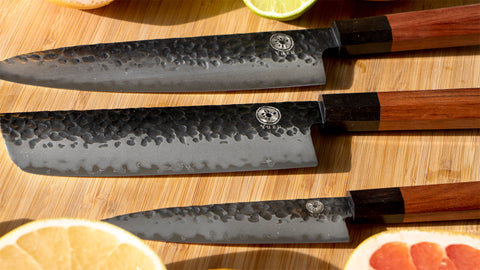
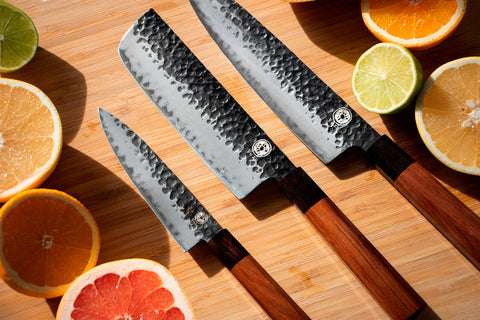
Many Japanese-made blades use wa handles: lightweight wooden handles (magnolia, ebony, sandalwood) with the blade tang burned into the wood. No rivets, no bolster. The result is a much lighter knife with the balance shifted toward the cutting edge.
Some Japanese knife brands offer Western-style (yo) handles to ease the transition for cooks used to German ergonomics. Performance is the same either way. Handle choice is mostly about what feels comfortable.
Durability and what each can handle
German knives tolerate more abuse. The softer steel flexes rather than chipping. The thicker blade handles lateral stress better. If you occasionally cut through a chicken joint, scrape food off the board with the edge, or accidentally drop the knife, a German blade survives better.
Japanese-made blades demand more respect. The hard, thin steel chips if it hits bone, frozen food, or the edge of a ceramic plate. Twisting or prying will damage the blade. You need to use them for what they're designed for: clean cuts through boneless proteins, vegetables, and herbs on a wooden or plastic board.
This isn't a flaw. It's the trade-off for getting a sharper, lighter, more precise tool. A Formula 1 car is more fragile than a Land Rover, but nobody calls that a design failure.
Maintenance
German knives are lower maintenance across the board. The softer steel responds well to a honing steel, which most home cooks already own. A few passes before each use keeps the edge aligned. When it does go dull, a basic sharpener or professional service gets it back quickly.
Japanese-made blades need whetstone sharpening. Pull-through sharpeners and electric grinders are too aggressive for the hard, thin steel. The good news: because the steel is harder, you sharpen far less often. A Japanese blade that gets sharpened every 2-3 months will outperform a German blade sharpened every 2-3 weeks.
Both types should be hand-washed and dried after use. Neither belongs in a dishwasher, though German knives survive it better.
Price
Entry-level German chef knives from Wüsthof, Zwilling, or Victorinox start at £50-80. Their mid-range models run £100-200.
Japanese-made kitchen knives start around the same price for factory-produced options. Our Yuzu gyuto is £109 with AUS-10 steel and san-mai construction, which is comparable to a mid-range Wüsthof. Artisan hand-forged blades go much higher, £200-500+.
The price comparison is closer than most people expect. You're not paying a premium for Japanese steel. You're paying for different engineering.
So which should you buy?
Get a German knife if you want something forgiving. If you're hard on your tools, don't want to learn whetstone sharpening, or need a knife that handles everything from delicate slicing to rough prep without complaint, German is the safer choice.
Get a Japanese-made blade if you care about the cutting experience. If you enjoy cooking, want the sharpest possible edge, and don't mind learning to care for a better tool, a gyuto or nakiri will change how prep feels. Once you've used a thin, hard blade on a ripe tomato, going back to a thick German edge feels like work.
Plenty of cooks own both. German knife for breaking down chicken and rough tasks. Japanese blade for everything else. For a full breakdown of what to look for, see our guide to choosing the best kitchen knife.