
Handmade Japanese Steel Knives: How They're Forged and Why It Matters
A handmade Japanese steel knife starts as raw steel and ends as a blade that can split a hair. Between those two points, a blacksmith heats, hammers, quenches, and grinds the metal through a process that hasn't changed much in centuries.
Japanese bladesmithing has roots in sword-making. When the samurai era ended, swordsmiths turned their techniques toward kitchen knives. The hard cutting edges, careful heat treatment, and precise grinding that went into katanas now go into gyutos and nakiris instead.
Here's how the process actually works, what separates handmade blades from factory production, and whether the difference is worth paying for.
How handmade Japanese steel knives are forged
The process varies between smiths and regions, but the stages are consistent. A single blade takes days to complete.
Selecting and preparing the steel
The smith chooses a core steel based on what the knife needs to do. High-carbon steels like White Paper (Shirogami) and Blue Paper (Aogami) are the traditional choices. They take a razor edge and sharpen easily, but they rust without care. Modern options like AUS-10 and VG-10 add chromium for stain resistance while keeping the hardness — our AUS-10 vs VG-10 comparison covers what separates these two popular stainless steels.
For laminated blades (san-mai construction), the smith also prepares softer steel for the outer layers. These protect the hard core from chipping and corrosion while the cutting edge stays sharp.
Forge welding
The smith heats the steel in a coal or gas forge until it glows bright orange, around 1,000°C. At that temperature, the metal is soft enough to shape and hot enough for the layers to bond. In san-mai construction, the smith hammers the hard core steel between two pieces of softer steel, fusing them into a single billet through repeated heating and hammering.
This is where hand-forging diverges from factory work. The smith reads the colour of the steel to judge temperature. Too cool and the layers won't bond. Too hot and the carbon burns out, ruining the steel's ability to hold an edge. There's no thermostat. Just experience.
Shaping the blade
Once the billet is welded, the smith draws it out into a rough blade shape using a power hammer or hand hammer. The blade gets longer and thinner with each pass. The smith works the metal while it's hot, returning it to the forge every few minutes as it cools.
This is where the blade's profile takes shape: the taper from spine to edge, the curve of the belly, the overall width and length. A gyuto needs a gentle curve for rocking cuts. A nakiri needs a dead-flat edge. The smith shapes each one differently.
Heat treatment: hardening and tempering
Heat treatment makes or breaks the blade. The smith heats it to its critical temperature (750-800°C for most steels), then quenches it rapidly in water or oil. This transforms the steel's crystal structure, making it extremely hard but also brittle.
Traditional smiths do the quench after dark. In low light, they can read the exact colour of the glowing steel more accurately. A few degrees off and the blade cracks in the quench or comes out too soft.
After hardening, the blade gets tempered: reheated to a lower temperature (150-200°C) and cooled slowly. This reduces brittleness while keeping hardness. The target for most Japanese kitchen knives is 58-65 HRC on the Rockwell scale, depending on the steel and intended use.
Grinding and sharpening
The hardened blade goes to a sharpener, often a separate craftsman (togishi). They grind the blade to its final thickness and create the cutting edge using a series of increasingly fine whetstones.
It's slow, careful work. The sharpener removes material fraction by fraction, checking the blade geometry constantly. A thin, even grind means the knife glides through food without resistance. An uneven grind means the blade steers sideways or wedges in dense ingredients.
The final edge is polished to a mirror finish or left with a kasumi (hazy) finish that shows the transition between the hard core and soft cladding.
Handle fitting and finishing
Japanese-style blades traditionally use wa handles, lightweight wooden handles made from ho wood (magnolia), ebony, or other hardwoods. The tang is heated and burned into the handle, creating a tight friction fit without glue or rivets.
The smith or a handle maker adds any final touches: engraving the maker's mark (mei), applying the kurouchi (blacksmith's finish) if the blade retains its forging scale, or polishing the blade to a specific finish.
Handmade vs factory-made: what's the actual difference?
Factory-made Japanese steel knives aren't bad. Many use the same steels as handmade blades and perform well. The differences are in the details.
Steel handling. A factory stamps or laser-cuts blade blanks from sheet steel. A smith forges the steel, refining its grain structure with each hammer blow. Forged steel generally has a tighter, more uniform grain, which translates to better edge retention and toughness.
Heat treatment. Factories use computer-controlled ovens with precise temperature settings. A smith reads the colour and adjusts in real time. Both can produce good results, but a skilled smith can optimise the heat treatment for each individual blade rather than applying the same recipe to a batch of hundreds.
Grinding. Machine grinding is consistent but leaves a uniform thickness profile. Hand grinding allows the sharpener to thin specific areas, create distal taper (gradual thinning from handle to tip), and adjust the geometry based on how the specific piece of steel behaves.
Consistency vs character. Factory knives within the same model are identical. Handmade knives vary slightly — each one has minor differences in weight, balance, and finish. Some people value that. Others prefer predictability.
What is kurouchi finish?
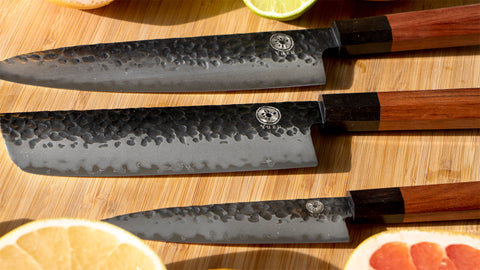
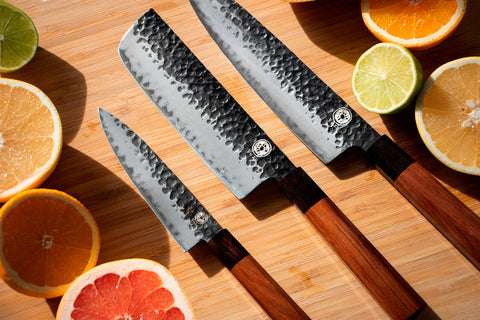
Kurouchi means "blacksmith's finish" in Japanese. It's the dark, rough-textured scale that forms on the blade's surface during forging. On factory knives, this scale is ground off to create a polished surface. On many handmade knives, it's left on deliberately.
It's not purely cosmetic. The textured surface creates tiny air pockets between the blade and whatever you're cutting, which helps food release instead of sticking. It also adds a layer of corrosion resistance to the cladding steel.
Our Yuzu knives use a kurouchi finish on the san-mai cladding. The AUS-10 cutting edge is exposed and polished, while the softer outer layers keep their forge scale.
San-mai construction: why laminate?
Most quality handmade Japanese steel knives use san-mai (three-layer) construction rather than a single piece of steel. The reason is practical.
Hard steel holds a sharp edge but chips easily. Soft steel is tough but goes dull fast. San-mai solves both problems. The hard core steel (like AUS-10 at 58-60 HRC) forms the cutting edge. Softer stainless steel cladding protects the sides of the blade from impact and corrosion.
You get the sharpness of carbon steel performance with stainless steel convenience. The trade-off? San-mai is harder to forge than single-steel construction because the smith needs to bond three layers cleanly without contamination or delamination.
Japanese knife-making regions
Japan has several historic knife-making centres, each with its own style.
Sakai (Osaka). The most famous centre for kitchen knives. Sakai has produced blades since the 16th century, originally for tobacco-cutting knives. Today it's known for professional-grade single-bevel knives. The work is divided among specialists: the blacksmith forges, the sharpener grinds, and the handle maker fits the handle.
Seki (Gifu). Japan's largest knife-production city, home to both handmade and factory operations. Seki tends toward stainless and semi-stainless steels, producing knives that balance performance with low maintenance. Many well-known Japanese knife brands manufacture here.
Takefu (Fukui). A smaller centre known for high-carbon steel knives and traditional techniques. Many independent smiths work here, producing knives with a more artisanal character.
Tosa (Kochi). Known for robust, rustic knives meant for heavy work. Tosa knives tend to be thicker and tougher than Sakai blades, built for farming and outdoor use as much as kitchen work.
Are handmade Japanese steel knives worth the price?
Handmade knives from individual smiths typically cost £150-500+, sometimes much more for renowned makers. Factory-made blades with good steel start around £60-120.
For pure cutting performance, the gap is smaller than the price difference suggests. A well-made factory knife with AUS-10 or VG-10 steel, properly heat-treated and ground, cuts beautifully. You don't need a hand-forged blade to get a sharp, capable kitchen knife.
What you get with handmade is the forging process's effect on steel quality, hand-ground geometry tuned to each individual blade, and the character of a tool made by one person. Whether that's worth paying double or triple is a personal call.
If you want hard steel, acute edge angles, san-mai construction, and kurouchi finish without the artisan price tag, that middle ground exists. Our gyuto, nakiri, petty, and bread knife use the same AUS-10 steel and san-mai construction found in knives costing twice as much. The difference is production scale, not quality of materials or technique.