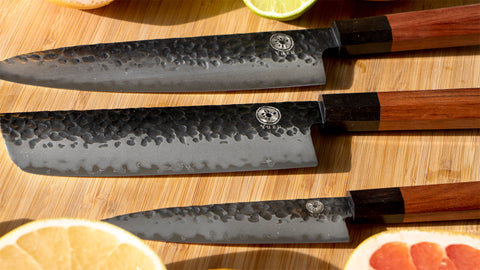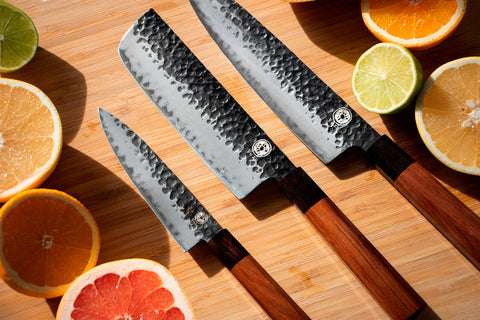

A Japanese vegetable knife is designed to do one thing well: cut vegetables cleanly and quickly. Where a Western chef's knife uses a curved blade and rocking motion, Japanese vegetable knives use a flat edge that contacts the cutting board all at once. One downward push and the cut is done.
This guide covers the main types of Japanese vegetable knives, explains the differences between them, and helps you decide which one (if any) belongs in your kitchen.
Why Use a Dedicated Vegetable Knife?
You can chop an onion with a chef's knife. You have been doing it for years and it works fine. So why would you bother with a separate vegetable knife?
Speed and consistency. A flat-edged vegetable knife cuts through a carrot in one clean stroke. A curved chef's knife needs a rocking motion to complete the same cut, and unless you get the full rock, the bottom stays attached. That partial-cut problem slows you down when you are working through a pile of vegetables for a stir-fry, soup, or salad prep.
The tall, rectangular blade also doubles as a scoop. Slide it under a pile of diced onion and transfer it straight to the pan. No need for your hands or a bench scraper.
If vegetables are a big part of your cooking, a dedicated vegetable knife speeds things up. If you mostly cook meat and use vegetables as a side, your gyuto already handles the job.
The Nakiri: The Home Cook's Vegetable Knife
The nakiri is the most common Japanese vegetable knife and the one most relevant for home cooks. The name comes from "na" (vegetable) and "kiri" (to cut). It appeared during the Edo period (1603-1868), when plant-based cooking was central to Japanese household meals.
What It Looks Like
A nakiri has a flat, rectangular blade that looks a bit like a small cleaver. Typical blade length runs 165-180mm. The blade is thin (under 2mm usually) and the edge is completely flat from heel to tip. Both sides are sharpened equally, making it a double-bevel knife.
People sometimes confuse it with a Chinese cleaver because of the rectangular shape. The difference is weight. A nakiri is light and thin, built for precision vegetable work. A Chinese cleaver is heavy, built for chopping through bone. Do not use a nakiri on bones. It will chip.
What It Does Well
- Straight chopping: Onions, carrots, courgettes, peppers. The flat edge means the entire blade hits the board at once. No half-attached pieces.
- Thin slicing: The thin blade and sharp edge make paper-thin cucumber or radish slices easy. Good for salads and garnishes.
- Dense vegetables: Butternut squash, sweet potato, celeriac. The flat edge gives you a controlled, straight entry instead of the blade wandering sideways.
- Herbs and leafy greens: The wide, flat blade bruises less than a curved knife that has to rock through delicate leaves.
What It Does Not Do
A nakiri is a specialist. It does not replace your chef's knife. It cannot handle rocking cuts (there is no curve to rock on). It is not great for cutting meat, breaking down poultry, or mincing with the tip. And the flat tip means no piercing or scoring work.
Think of it as an addition to your knife collection, not a replacement. Our Yuzu Nakiri sits alongside the gyuto and petty as part of the Three Knife Set. Each handles different tasks. For a full deep dive, see our complete nakiri guide.
The Usuba: The Professional's Vegetable Knife
The usuba is the nakiri's older, more demanding sibling. Where the nakiri was developed for home cooks, the usuba is the traditional vegetable knife used in professional Japanese kitchens.
How It Differs from a Nakiri
The key difference is the bevel. An usuba is a single-bevel knife, sharpened on one side only. This allows for incredibly thin, precise cuts but makes the knife harder to control. The single bevel naturally pushes the blade to one side as you cut, so you need to actively compensate to keep your cuts straight.
Usuba knives are also heavier and thicker at the spine than nakiris. This extra weight helps with the controlled push-cut technique used in professional vegetable preparation.
There are two regional styles:
- Edo usuba (Kanto style): Square tip, associated with Tokyo. More common.
- Kamagata usuba (Kansai style): Pointed tip, associated with Osaka and Kyoto. The pointed tip helps with detailed decorative work.
Who Should Buy an Usuba?
Very few people. If you are a home cook, get a nakiri. An usuba requires proper training to use well and to sharpen correctly (single-bevel sharpening is a different skill from double-bevel). It is also typically right-hand specific, since the bevel is ground on one side.
Usuba knives make sense if you are training in traditional Japanese cuisine, working in a professional Japanese kitchen, or practising katsuramuki (the technique of peeling a daikon radish into one continuous paper-thin sheet). For everyone else, the nakiri gives you 90% of the performance with none of the learning curve.
How to Use a Japanese Vegetable Knife
The technique is different from a Western chef's knife. No rocking. No tip-anchored mincing. Japanese vegetable knives use two main cutting motions:
The Push Cut
Guide the blade forward and downward in a single motion. The edge enters the food at a slight angle and passes straight through until the entire blade contacts the board. This is the primary cut for most vegetables.
The Straight Chop
Lift the knife and bring it straight down. The flat edge ensures clean contact across the full width of the ingredient. Works well for carrots, celery, spring onions, and anything you are cutting into rounds or half-moons.
The Guide Hand
Curl the fingers of your non-cutting hand and use your knuckles as a guide for the blade. The flat side of the nakiri rides against your knuckles, controlling the thickness of each slice. Tuck your fingertips behind the knuckle line. This is the same technique used with any knife but matters more with a nakiri because the wide blade gives you a larger surface to guide against.
Speed comes with practice. Start slow, focus on consistent thickness, and the pace will build naturally.
What to Look for When Buying
If you have decided a Japanese vegetable knife is right for you (and the nakiri is the one for most people), here is what to pay attention to:
Steel Type
The steel determines how sharp the knife gets, how long it stays sharp, and how much care it needs. AUS-10 is a solid choice: hard enough for a fine edge (HRC 58-60), resistant to rust, and easy to sharpen at home. Carbon steels like White Paper and Blue Paper take a keener edge but require more maintenance to prevent rust.
Blade Length
165mm and 180mm are the standard nakiri sizes. 165mm is more nimble and suits smaller hands or kitchens. 180mm gives you more blade to work with and is better for large batches of vegetables. Either works well.
Handle Style
Japanese wa handles (octagonal or D-shaped wooden handles) are lighter and position the balance point closer to the blade. Western-style handles are heavier and shift the balance toward the handle. For a vegetable knife where you want the blade to do the work, a wa handle usually feels more natural.
Weight and Balance
A nakiri should feel light and responsive. You are making quick, repetitive cuts and a heavy knife tires your hand. The Yuzu Nakiri weighs 250g with a wa handle in ebony and sandalwood, which keeps things balanced without being heavy.
Caring for Your Vegetable Knife
Japanese vegetable knives follow the same care rules as any Japanese kitchen knife:
- Hand wash and dry immediately. No dishwasher. The thin blade edge is vulnerable to contact with other utensils in a wash cycle.
- Use wood or plastic cutting boards. Glass, marble, and ceramic boards will dull the edge quickly.
- Store with a saya or in a knife block. Do not toss it loose in a drawer where the edge can bang against other metal. A wooden saya keeps the blade protected.
- Sharpen with a whetstone. A dual-sided whetstone at 15 degrees per side maintains the factory edge on a nakiri. Our whetstone guide walks through the process.
- Avoid hard foods. No bones, no frozen food, no coconut shells. The thin blade is designed for vegetables, not for brute force.
Nakiri vs Gyuto for Vegetables: Do You Need Both?
A gyuto handles vegetables just fine. If you are cooking for one or two people and vegetables are not the centrepiece of every meal, you can get by without a nakiri.
The nakiri earns its place when:
- You do a lot of vegetable prep (meal prepping, big stir-fries, soups, plant-based cooking)
- You want uniform, precise cuts without fussing over technique
- You find the rocking motion of a curved knife tiring during long prep sessions
- You appreciate having the right tool for the job rather than one knife for everything
Many home cooks start with a gyuto and add a nakiri once they realise how much time they spend chopping vegetables. The two work well together, which is why they are paired in our Three Knife Set.
Conclusion
Japanese vegetable knives are built for a specific job and they do it well. The nakiri gives home cooks a flat blade that makes vegetable prep faster and more consistent. The usuba takes that further for professional use, but comes with a steep learning curve.
For most people, a nakiri alongside a gyuto and a petty knife covers everything. If vegetables are a regular part of your cooking, the nakiri is worth considering.