
Japanese Knife Types Explained: A Complete Guide to Every Blade
Japanese knife types each serve a distinct purpose in the kitchen. Where a Western block set gives you six variations of roughly the same thing, a Japanese knife collection is built around specialisation. Each blade shape has been refined over centuries for specific ingredients and cutting techniques.
This guide covers the knife types you'll actually use, explains what makes each one different, and helps you work out which ones belong in your kitchen.
How Japanese Knives Differ from Western Knives
Before getting into individual types, it helps to understand what sets Japanese knives apart. The main differences:
- Thinner blades: Typically 1.5-2mm thick versus 2.5-3mm for Western knives. Less metal means less resistance when cutting.
- Harder steel: Japanese knives commonly rate 58-65 on the Rockwell hardness scale (HRC), while Western knives tend to be around 54-58 HRC. Harder steel holds a sharper edge longer.
- Sharper edge angles: Most Japanese knives are sharpened at 12-15 degrees per side, compared to 20-22 degrees for Western blades. The result is a sharper edge.
These characteristics mean Japanese knives cut more precisely with less effort. The tradeoff is that they need a bit more care. No dishwashers, no cutting through bones or frozen food, and periodic sharpening with a whetstone rather than a honing rod.
Japanese knives also split into two broad families: double-bevel (sharpened on both sides) and single-bevel (sharpened on one side only). Double-bevel knives work for everyone. Single-bevel knives are specialist tools used mainly by trained sushi chefs and professional Japanese cooks.
All-Purpose Chef Knives
Gyuto
The gyuto is the Japanese equivalent of a Western chef's knife. The name translates to "cow sword," a nod to its origins when Japan began adopting Western meat-cutting techniques after the Meiji Restoration.
A gyuto typically runs 180-270mm in blade length, with 210mm being the most popular size. It handles vegetables, meat, fish, and herbs equally well. The blade curves gently from heel to tip, so it works with both a rocking motion and straight push cuts.
If you're buying one Japanese knife, this is probably it. Our Yuzu Gyuto uses AUS-10 steel with san-mai construction at 205mm, which balances reach and control well. You can read more in our complete gyuto guide.
Santoku
The santoku means "three virtues," a reference to its ability to handle meat, fish, and vegetables. It's shorter than a gyuto (usually 165-180mm), with a flatter profile and a sheep's foot tip that curves down rather than pointing forward.
Santoku knives became popular in Japanese households after World War II as a practical all-rounder. The shorter blade makes them a good fit for cooks with smaller hands or limited counter space. They excel at the up-and-down chopping style common in Japanese home cooking but are less suited to rocking cuts.
Bunka
The bunka is a more recent design that blends the santoku's width with a distinctive reverse-tanto (angled) tip. That pointed tip gives better precision work than a santoku while keeping the wide blade useful for scooping chopped ingredients off the board.
Bunka knives have gained popularity with home cooks who want something slightly different from the standard gyuto or santoku shape.
Vegetable Knives
Nakiri
The nakiri is a dedicated vegetable knife with a flat, rectangular blade. The entire edge contacts the cutting board at once, which means clean cuts through carrots, onions, and leafy greens without the partial-cut problem you get with curved blades.
Nakiri knives are double-bevel, making them accessible for home cooks. The typical blade length is between 165-180mm. The tall blade profile also works well as a scoop for transferring chopped ingredients into a pan.
If vegetables make up a significant part of your cooking, a nakiri will make prep faster. Our Yuzu Nakiri is built for this purpose. For a deeper look, see our complete nakiri guide.
Usuba
The usuba is the professional-grade vegetable knife. It looks similar to a nakiri but uses a single-bevel edge, which allows for paper-thin cuts and the intricate decorative work (called katsuramuki) you see in high-end Japanese restaurants.
Usuba knives demand real skill to use properly. The single bevel naturally steers the blade to one side, so cuts drift if you don't compensate. These are specialist tools, not everyday home kitchen knives.
Utility and Precision Knives
Petty
The petty knife is Japan's answer to the Western paring knife. It handles the small, detailed tasks that a larger blade can't manage well: peeling fruit, deveining prawns, trimming fat, slicing garlic, and scoring bread dough.
Petty knives range from 80-150mm. The longer end of that range blurs into utility knife territory and can handle light board work too. The Yuzu Petty is a practical size that covers both in-hand work and small cutting board tasks. More detail in our petty knife guide.
Kiritsuke
The kiritsuke is traditionally a single-bevel knife that combines elements of the yanagiba (sushi slicer) and usuba (vegetable knife). In Japanese professional kitchens, only the head chef is permitted to use one. It signals rank.
Modern double-bevel versions exist and function as an angular alternative to the gyuto. They look striking, with a clipped reverse-tanto tip, but don't offer any real functional advantage over a good gyuto for most cooks.
Slicing and Fish Knives
Yanagiba
The yanagiba (or yanagi) is the classic sushi and sashimi knife. Its long, narrow, single-bevel blade (typically 240-330mm) is designed to cut fish in a single drawing stroke. That one-pull technique preserves the cell structure of raw fish, which directly affects texture and appearance on the plate.
Unless you regularly prepare sashimi or nigiri at home, this is not a knife you need.
Sujihiki
The sujihiki is a double-bevel slicing knife that serves a similar purpose to a Western carving knife. It's long and narrow, built for slicing cooked meats, smoked fish, and charcuterie with minimal tearing.
Think of it as the more accessible cousin of the yanagiba. It works for both Japanese and Western proteins and doesn't require the single-bevel technique training.
Deba
The deba is a thick, heavy single-bevel knife designed for breaking down whole fish. It can cut through fish bones and cartilage that would chip a thinner blade. Deba knives range from small (105mm) for filleting smaller fish to large (210mm+) for breaking down bigger catches.
This is another specialist tool. Home cooks who buy whole fish regularly might find one useful, but it's not essential.
Bread Knives
Japanese bread knives use the same high-quality steel as other Japanese blades, but with a serrated edge designed to grip and slice through hard crusts without crushing the soft interior. The serrations on Japanese bread knives tend to be finer and more evenly spaced than Western versions, which translates to cleaner cuts with fewer crumbs.
A good bread knife also handles tasks like slicing tomatoes, cake layers, and anything else with a tough exterior and delicate inside. The Yuzu Bread Knife has a 260mm blade in AUS-10 steel, long enough for large sourdough loaves.
Pocket and Outdoor Knives
Higonokami
The higonokami is a traditional Japanese folding knife that dates back to the late 1800s. It's not a kitchen knife, but it's worth mentioning because it represents a different strand of Japanese blade-making culture.
Higonokami knives use a simple friction-fold mechanism with no locking blade. They're used for everyday cutting tasks, outdoor activities, crafts, and food preparation on the go. Our Yuzu Higonokami carries this tradition forward. Learn more in our higonokami guide.
Japanese Knife Names: Quick Reference
Japanese knife names can be confusing at first. Here's a quick reference for the main types, with pronunciation and meaning:
| Name | Pronunciation | Meaning | Primary Use |
|---|---|---|---|
| Gyuto | gyoo-toh | Cow sword | All-purpose chef's knife |
| Nakiri | nah-kee-ree | Knife for cutting greens | Vegetables |
| Santoku | san-toh-koo | Three virtues | All-purpose (meat, fish, vegetables) |
| Petty | pet-tee | From French "petit" (small) | Detail work, paring, trimming |
| Yanagiba | yah-nah-gee-bah | Willow blade | Sashimi, raw fish slicing |
| Deba | deh-bah | Protruding blade | Whole fish butchery |
| Usuba | oo-soo-bah | Thin blade | Decorative vegetable cuts |
| Sujihiki | soo-jee-hee-kee | Flesh slicer | Slicing cooked meats and fish |
| Kiritsuke | kee-ree-tsoo-keh | Cut and attach | Sashimi and vegetables (professional) |
| Higonokami | hee-goh-noh-kah-mee | Lord of Higo (historical region) | Pocket knife, everyday carry |
Which Japanese Knife Types Do You Actually Need?
Most home cooks can cover nearly everything with two or three knives:
- A gyuto (chef's knife) for 80% of kitchen tasks
- A petty knife for detail work and in-hand cutting
- A nakiri if you cook a lot of vegetables, or a bread knife if you bake or buy crusty loaves regularly
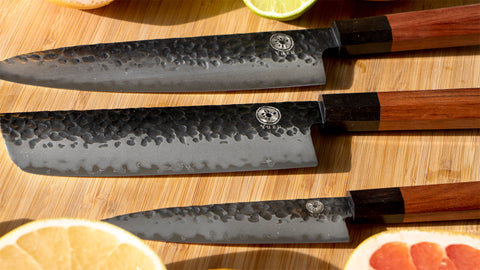
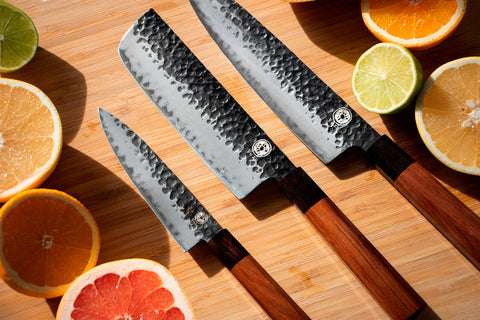
That combination handles everything from breaking down a chicken to finely dicing shallots to slicing sourdough. Our Three Knife Set (gyuto, nakiri, petty) and Four Knife Set (adds the bread knife) are built around exactly this logic.
Single-bevel knives like the yanagiba, usuba, and deba are worth considering only if you work in a professional kitchen or prepare traditional Japanese cuisine regularly. For most people, double-bevel knives do the job and are far easier to maintain.
What to Look for in Japanese Knife Steel
The steel matters as much as the shape. Japanese kitchen knives generally use one of these:
| Steel Type | Hardness (HRC) | Edge Retention | Ease of Sharpening | Rust Resistance |
|---|---|---|---|---|
| AUS-10 | 58-60 | High | High | High |
| VG-10 | 59-61 | High | Medium | High |
| Blue Paper Steel | 63-65 | Very High | Low | Low |
| White Paper Steel | 61-64 | High | High | Low |
AUS-10 strikes a good balance: hard enough to hold an edge, tough enough to resist chipping, and stainless enough that you don't need to dry the blade after every use. It's also straightforward to sharpen at home. Our steel guide covers this in more detail.
Carbon steels (blue and white paper) take a sharper edge but rust easily. They suit professionals who enjoy the ritual of knife care. Stainless options like AUS-10 and VG-10 are more forgiving for daily home use — if you're weighing the two, our AUS-10 vs VG-10 comparison breaks down the differences.
Conclusion
Japanese knives are built around the idea that the right tool for the job beats a jack-of-all-trades. A gyuto handles general prep. A nakiri makes vegetable work easier. A petty takes care of the fiddly stuff. And a bread knife stops you from crushing your sourdough.
You don't need every type on this list. Start with a gyuto, add what your cooking demands, and build from there. Every Yuzu knife uses hand-forged AUS-10 steel in a san-mai construction with a traditional kurouchi finish, so whichever type you choose, the quality is consistent across the range.