
Japanese Knife Sets: How to Build Your Collection
Most Western knife sets come in a big block with 12 to 15 blades. Half of them sit untouched for years. Japanese knife sets take the opposite approach. Fewer knives, each one designed for specific tasks, all of them getting regular use.
The question isn't which branded set to buy. It's which combination of knives actually matches how you cook. This guide walks through the knives worth owning, how many you need, and what to look for in the steel and construction.
What should be in a Japanese knife set?
Japanese kitchen culture doesn't really do the massive knife block. Instead, cooks build a collection of three to five blades, each with a clear job. Here are the four that cover virtually everything a home cook encounters.
Gyuto: your main knife
The gyuto is the Japanese equivalent of a Western chef's knife, but thinner and lighter. A 200-210mm gyuto handles slicing, dicing, and chopping across meat, fish, and vegetables. If you're only buying one Japanese knife, this is it. Our gyuto guide goes deeper into blade profiles and technique.
Nakiri: the vegetable knife
The nakiri has a flat, rectangular blade that makes full contact with the cutting board in a single downward stroke. No rocking motion needed. It's faster and more precise for vegetable prep than a chef's knife, particularly when you're working through large volumes of onions, herbs, or leafy greens.
Once people try a nakiri for vegetable work, most stop reaching for their gyuto. There's a detailed breakdown in our nakiri knife guide.
Petty knife: the detail blade
A petty knife is the Japanese version of a paring knife, usually 120-150mm. It handles anything that feels awkward with a larger blade: peeling fruit, trimming fat, deveining shrimp, slicing garlic cloves, making garnishes.
Most people underestimate how often they need a small blade until they actually have one around. Professional chefs keep a petty within arm's reach throughout service. More on sizes and uses in our petty knife guide.
Bread knife: the serrated all-rounder
A Japanese bread knife uses the same thin, precise construction as the straight-edged blades. The serrations cut through crusty sourdough without crushing the crumb, but the knife earns its place beyond bread. Tomatoes, citrus, cakes, and anything with a tough skin and soft interior.
Our bread knife article explains why the serration pattern matters more than blade length.
How many knives do you actually need?
It depends on how you cook. Here's how to think about building your set in stages.
Two knives: the starter pair
A gyuto and a petty knife cover most tasks for someone getting started with Japanese knives. The gyuto handles big jobs, the petty handles small ones. This is enough for most weeknight cooking.
The gyuto starter kit pairs the knife with a wooden saya sheath and a whetstone, so you have everything to maintain it from day one.
Three knives: the core collection
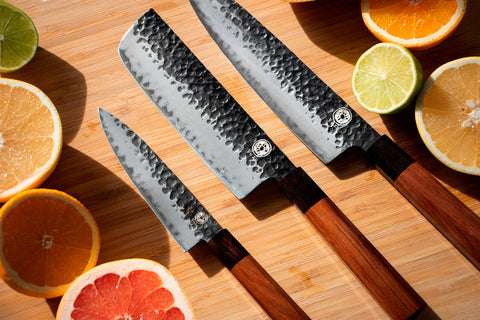
Adding a nakiri to the gyuto and petty gives you a set that handles roughly 95% of kitchen tasks. This is the combination most home cooks settle on. The nakiri takes over vegetable prep, freeing the gyuto for proteins and general cutting.
A three knife set is often cheaper than buying the same knives individually, and the blades are matched in steel and construction so they feel consistent in your hand.
Four knives: the complete set
The bread knife rounds out the collection. If you bake regularly or eat a lot of crusty bread, it earns its spot quickly. But even if bread isn't a daily thing, the serrated blade handles tasks the other three can't.
A four knife set covers everything without a single filler blade. Every knife gets regular use.
What to look for in Japanese knife set steel
The steel determines how sharp the knife gets, how long it stays sharp, and how much maintenance it demands. Japanese knives use harder steel than Western blades, typically 58-62 HRC on the Rockwell hardness scale compared to 54-58 HRC for German knives.
For a set you'll use daily, high-carbon stainless steel hits the right balance. It holds an edge well, resists corrosion, and doesn't require the constant upkeep of pure carbon steel. AUS-10 steel at 58-60 HRC is a strong option in this category. It stays sharp, resists chipping better than harder steels, and sharpens easily on a whetstone.
VG-10 is another popular choice, sitting at 59-61 HRC. It holds an edge slightly longer but can be more brittle and harder to sharpen at home. Our AUS-10 vs VG-10 comparison breaks down the practical differences.
Pure carbon steel knives can reach 63-65 HRC and take the sharpest possible edge, but they need drying after every use and develop a patina over time. They're suited to experienced cooks who enjoy the ritual of knife care, not beginners building their first set.
Construction matters too
Look for san-mai (three-layer) construction. A hard steel core provides the cutting edge, while softer stainless steel outer layers protect against chips and corrosion. This is how traditional Japanese hand-forged blades are built, and it's still the best approach for a knife that performs well and lasts.
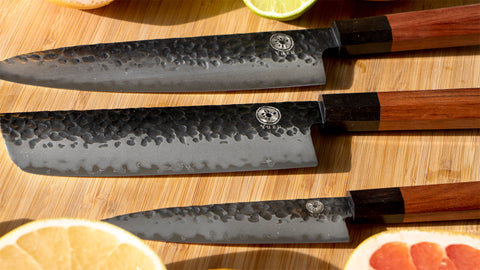
A kurouchi (blacksmith's) finish on the blade is a sign of forged construction. The dark, textured surface helps prevent food from sticking and adds corrosion resistance. The look is a bonus; the real value is practical.
Sets vs buying individual knives
Both approaches work. The right one depends on your budget and how quickly you want a complete collection.
Sets save money. A three knife set at £229 costs less than buying the gyuto, nakiri, and petty individually at £293. The four knife set saves £103 off the individual price, and the knives are matched in steel, handle material, and balance.
Buying individually makes more sense if you already own a good chef's knife and just want to add a nakiri. You can mix blade lengths or handle styles across different brands, though you lose the consistency of a matched set.
A starter kit splits the difference. One knife paired with a saya and whetstone, so you have maintenance covered from day one. Buy a kit now, add individual knives later as your cooking changes. It's also the easiest knife gift to get right.
What about accessories?
Japanese knives need different storage and maintenance than a Western block set. Two things are worth picking up alongside your knives.
A whetstone for sharpening
Japanese knives are sharpened at 15 degrees, a finer angle than most Western blades. A pull-through sharpener will damage that edge. A dual-sided whetstone with a coarse and fine grit is the proper tool. It takes practice, but the results are better than any electric sharpener can achieve. Our whetstone sharpening guide walks through the process step by step.
Saya sheaths for protection
A saya is a wooden sheath that protects the blade edge during storage. If you're keeping knives in a drawer rather than on a magnetic strip, sayas prevent the edge from chipping against other utensils. They also protect the kurouchi finish from scratches.
You can buy sayas individually or as a matched bundle to go with your knife set.
How to care for a Japanese knife set
Japanese knives last years if you treat them right. The rules are simple.
- Hand wash only. Never put Japanese knives in the dishwasher. The heat and detergent damage the edge and handle.
- Dry them straight away. Even stainless steel benefits from being towelled off right after washing.
- Use a wood or plastic cutting board. Glass and ceramic boards dull the edge quickly.
- Skip bones and frozen food. Japanese steel is harder but thinner than Western blades, so it can chip on impact. Use a Western knife or cleaver for heavy-duty tasks.
- Sharpen on a whetstone every few months. A few minutes restores the factory edge.
That's it. No special oils, no complicated routines. The sharpening angle guide covers the technical details, and our guide to sharpening stones helps you pick the right one.
How Japanese knife sets compare to Western sets
Western knife sets, particularly German brands like Wusthof and Zwilling, prioritise versatility in each blade. A Western chef's knife is heavier, uses a rocking motion, and the softer steel is more forgiving if you hit a bone or twist the blade.
Japanese sets prioritise precision. The thinner blades produce cleaner cuts, the harder steel stays sharp longer, and the lighter weight reduces fatigue during long prep sessions. The tradeoff is that Japanese knives need more careful handling.
For most home cooks, the sharper edge and lighter feel make Japanese knives more enjoyable to use. Our Japanese vs German knives comparison covers the full breakdown. If you're coming from a Western knife block and want to switch, a three knife Japanese set replaces the chef's knife, paring knife, and vegetable knife you're already using.
Building your set over time
You don't need everything at once. The most practical approach is to start with one or two knives and add as you identify gaps in your cooking.
Start with a gyuto. It handles the widest range of tasks. A starter kit gives you the knife, saya, and whetstone together.
After a month or two, add a petty knife for detail work. You'll notice how often you need a small blade once you start paying attention.
From there, a nakiri changes how you handle vegetables, and a bread knife fills the last real gap. Or skip the staged approach and pick up a three knife set or four knife set for the best value.
Three or four good Japanese knives will outperform a 15-piece block set that costs twice as much. Nothing gathering dust in a drawer. Browse the full range of Japanese knife types to see what fits your kitchen.