
Best Japanese Kitchen Knives: How to Pick the Right Blade for Your Cooking
The best Japanese kitchen knife depends on what you cook most. A home cook who makes stir-fries every night needs a different blade than someone who spends weekends baking sourdough.
Japanese knives are thinner and harder than their Western equivalents, and they take a sharper edge. But "Japanese knife" covers everything from a flat-bladed nakiri to a long serrated bread knife. Picking the wrong type means fighting your knife instead of working with it.
This guide breaks down the best Japanese kitchen knife for each cooking task, what to look for in the steel and construction, and how to keep a good blade performing for years.
What makes a Japanese kitchen knife better than a Western one?
Three things set Japanese kitchen knives apart from Western blades.
Harder steel. Japanese knives use steel rated at 58-65 HRC (Rockwell hardness), compared to 54-58 for most German knives. Harder steel holds a sharper edge longer, which means less time sharpening and cleaner cuts through food. If you want to understand how Japanese and German knives actually compare, we break it down in detail.
Thinner blades. Because the steel is harder, Japanese blades can be ground thinner without bending or rolling. A thinner blade means less resistance when cutting, which translates to precise cuts and less crushing of delicate ingredients like herbs or ripe tomatoes.
Sharper edge angles. Most Japanese knives are sharpened to 15 degrees per side, compared to 20-25 degrees for Western knives. The acute angle slices through food with noticeably less effort.
The trade-off is that Japanese knives need more careful handling. They should not be used on bones or frozen ingredients, and they perform best when sharpened on a whetstone rather than a honing steel. But if you look after them, the difference in cutting performance is obvious from the first use.
Best Japanese kitchen knife for everyday cooking: the gyuto
If you could only own one Japanese knife, make it a gyuto. It handles about 90% of kitchen tasks: slicing meat, chopping vegetables, mincing herbs, portioning chicken.
The gyuto is Japan's answer to the Western chef's knife, but lighter and thinner. A 210mm gyuto typically weighs around 250g, making it noticeably less tiring than a heavier German chef's knife during a long prep session. The blade curves gently toward the tip, which lets you rock-chop when you need to but also makes clean push-cuts through vegetables.
For most home cooks, a gyuto in AUS-10 or VG-10 steel with a 200-210mm blade is the right size. Long enough for large cuts of meat and butternut squash, short enough to feel controlled in everyday use.
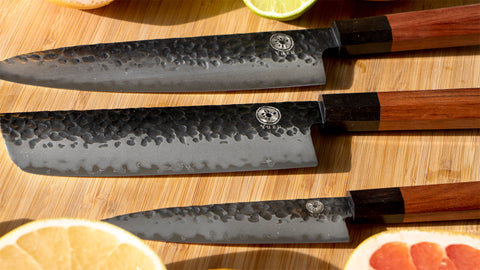
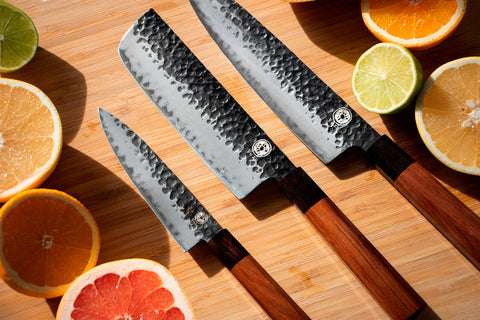
The Yuzu Gyuto uses AUS-10 steel (HRC 58-60) in a three-layer San-Mai construction: a hard cutting core sandwiched between softer stainless outer layers for corrosion resistance. At 205mm and 250g, it sits right in that versatile all-rounder range.
Best Japanese knife for vegetables: the nakiri
The nakiri is a flat-bladed vegetable knife that cuts differently from anything in a Western knife set. The entire cutting edge contacts the board at once, so every stroke cuts all the way through without rocking or sawing.
This makes the nakiri excellent for:
- Dicing onions with uniform cuts
- Julienning carrots or peppers into thin strips
- Cutting leafy greens without bruising the leaves
- Using the flat side to smash garlic or scoop chopped food off the board
If your cooking involves a lot of vegetable prep, a nakiri will save you time. The Yuzu Nakiri uses the same AUS-10 San-Mai construction as the gyuto, with a kurouchi (blacksmith's) finish that helps prevent food from sticking to the blade during rapid chopping.
Best Japanese knife for precision work: the petty
A petty knife handles everything a chef's knife is too big for: peeling fruit, trimming fat from meat, deveining prawns, cutting small garnishes.
It sits between a Western paring knife and a utility knife in size, typically around 120-150mm. Light enough for in-hand work like peeling and turning, but with enough blade length to use on a cutting board when you need it.
Most home cooks don't realise how much time they waste using an oversized knife for small tasks. A good petty knife is more precise and more manoeuvrable, and that makes detailed prep work both faster and safer.
Best Japanese bread knife
Japanese bread knives are an underrated category. The combination of harder steel and finer serrations means cleaner cuts through crusty bread without crushing the soft crumb underneath.
A typical Western bread knife uses wide, aggressive teeth. A Japanese bread knife uses more teeth per inch, each one finer, so the blade grips the crust without tearing. The result is a thin, even crust line with minimal crumbing.
The Yuzu Bread Knife at 260mm has enough length to handle large sourdough loaves in a single smooth stroke.
Do you need a Japanese knife set?
Buying individually lets you pick exactly the right blade for your cooking. But if you know you want a full setup, a set saves money over buying separately.
A three-knife set (gyuto, nakiri, petty) covers most cooking tasks and saves you money compared to buying each knife on its own. For complete coverage including bread, the four-knife set saves even more.
If you're new to Japanese knives and want to start with one blade plus the essentials to maintain it, a starter kit bundles a knife with a whetstone and a wooden saya (sheath) at a reduced price.
How to tell if a Japanese knife is good quality
Steel type and hardness
The steel determines how sharp the knife gets, how long it stays sharp, and how easily it resharpens. For home cooks, you want something in the 58-62 HRC range: hard enough for excellent edge retention, not so hard that the blade becomes brittle or difficult to sharpen yourself.
AUS-10 steel lands right in that range at HRC 58-60. It takes a razor edge, resharpens easily on a whetstone, and resists corrosion better than most high-carbon alternatives. VG-10 (HRC 59-61) is another solid choice, though it can be slightly more prone to chipping under lateral stress. Different Japanese knife brands favour different steels, so knowing what you want narrows the field.
Blade construction
San-Mai (three-layer) construction sandwiches a hard cutting core between softer stainless outer layers. This gives you the sharpness of high-carbon steel with a body that absorbs impact and resists rust. Most Japanese knives in the mid-price range use this approach.
The kurouchi (blacksmith's) finish on some blades is functional, not just cosmetic. The dark, textured surface reduces food sticking and adds natural rust protection to the exposed steel.
Handle design
Japanese knives typically use either a wa (traditional Japanese) handle or a yo (Western-style) handle. Wa handles are lighter, which shifts the balance point forward toward the blade. Most Japanese knife users prefer this because the blade's weight does the cutting rather than your arm.
Quality wa handles use hardwoods like ebony or sandalwood rather than plastic composites. Check that the handle sits flush against the blade collar with no gaps where moisture or food particles can collect.
How to look after a Japanese kitchen knife
Japanese knives will last for decades with basic care, but they need different treatment than Western knives.
Hand wash and dry straight away. Never put a Japanese knife in the dishwasher. The detergent, heat, and contact with other items will dull the edge and can corrode the steel.
Sharpen with a whetstone. Japanese steel is too hard for a honing rod. A dual-sided whetstone (1000/6000 grit) is all you need. A quick session every 4-6 weeks keeps the edge razor-sharp.
Protect the edge in storage. A wooden saya prevents the blade from knocking against other utensils in a drawer. It is the cheapest way to extend the working life of your knife.
Frequently asked questions
What is the best Japanese kitchen knife for a beginner?
A gyuto (Japanese chef's knife) in the 200-210mm range. It handles the widest variety of kitchen tasks, and if you are used to a Western chef's knife, the transition feels natural. The blade shape is similar, just thinner and lighter. Pair it with a whetstone and you are set.
Are Japanese kitchen knives worth the price?
If you cook regularly, yes. A quality Japanese knife will outperform a Western knife at twice the price in terms of sharpness, edge retention, and cutting precision. The harder steel means fewer sharpenings per year, and the thinner blade reduces fatigue during long prep sessions. Proper care (hand washing, whetstone sharpening, a saya for storage) will keep the knife performing for decades.
What is the difference between a gyuto and a santoku?
Both are all-purpose Japanese knives. A gyuto has a curved blade profile that allows rock-chopping (similar to a Western chef's knife), while a santoku has a flatter profile suited to straight up-and-down chopping. Gyutos are longer (typically 210mm vs 165-180mm), giving more blade contact when slicing larger items. For most Western home cooks, a gyuto is the more versatile choice.
How often should I sharpen a Japanese kitchen knife?
For a home cook using the knife daily, sharpening every 4-6 weeks is typical. You will know it is time when the knife starts sliding on tomato skin instead of biting straight in. AUS-10 steel at HRC 58-60 holds its edge well between sessions, and a 5-10 minute pass on a whetstone restores a full cutting edge.