
AUS-10 vs VG-10 Steel: Which Is Actually Better for Kitchen Knives?
If you're shopping for a Japanese kitchen knife, you've probably run into AUS-10 and VG-10 as the two most common steel options. Both are high-carbon stainless steels made in Japan. Both sit in the 58-61 HRC hardness range. Both resist corrosion well enough for daily kitchen use. On paper, they look nearly identical.
In practice, they behave differently. Which one is "better" depends on how you cook, how you sharpen, and what you actually care about in a knife. Neither is objectively superior. It comes down to which tradeoffs you're willing to make.
What Are AUS-10 and VG-10?
Both steels were developed in Seki, Japan's historic blade-making region, but by different manufacturers with different design goals.
AUS-10
Manufactured by Aichi Steel Corporation, AUS-10 is a high-carbon stainless steel rated at 58-60 HRC. Aichi designed it to be a workhorse: hard enough to hold an edge, tough enough to resist chipping when things go wrong. The carbon content sits around 0.95-1.10%, with vanadium for wear resistance and molybdenum for toughness.
VG-10
Made by Takefu Special Steel, VG-10 (which stands for V Gold 10) is a premium stainless steel rated at 59-61 HRC. It has slightly higher carbon content (around 0.95-1.05%) and notably more cobalt (about 1.5%), which increases hardness and wear resistance. VG-10 was built for high-end cutlery where holding an edge as long as possible is the point. It's become the default premium steel for a lot of Japanese knife brands.
Side-by-Side Comparison
| Property | AUS-10 | VG-10 |
|---|---|---|
| Hardness (HRC) | 58-60 | 59-61 |
| Edge retention | Good, holds a working edge through heavy use | Very good, stays sharp slightly longer |
| Toughness | High, resists chipping well | Moderate, more prone to micro-chipping |
| Ease of sharpening | Easy, responds quickly on a whetstone | Moderate, harder carbides need more patience |
| Corrosion resistance | High | High (slight edge from higher chromium) |
| Sharpening frequency | Every 2-4 weeks with regular use | Every 3-6 weeks with regular use |
| Typical price range | Mid-range | Mid-to-premium |
The numbers are close. What separates them is feel and forgiveness.
Where AUS-10 Wins
Toughness and chip resistance
AUS-10's slightly lower hardness gives it a real advantage in toughness. The edge absorbs minor impacts (hitting a bone, catching the edge of a cutting board, rocking through dense root vegetables) without developing micro-chips along the cutting edge. VG-10 is more brittle. Small lateral forces or unexpected impacts are more likely to chip it. If you cook fast and don't baby your knives, this difference matters.
Sharpening
This is where the gap is widest. AUS-10 responds to a whetstone almost immediately. A few minutes per side on a 1000-grit stone brings back a razor edge. VG-10's harder carbide structure resists the stone more, so you'll spend roughly twice as long to get the same result. For experienced sharpeners, that's just patience. For anyone still learning, AUS-10 is far more forgiving of imperfect angle technique.
Value
AUS-10 costs less to produce than VG-10. That savings passes through to the knife price. You get roughly 80-90% of VG-10's performance for noticeably less money.
Where VG-10 Wins
Edge retention
VG-10 holds an edge longer. The higher cobalt content and slightly greater hardness mean you'll sharpen less often. If you cook professionally and need your knife to stay sharp through a full service without touching up, that extra week or two between sharpenings adds up. The difference isn't dramatic, maybe 30-40% longer between sharpenings, but it's real.
Maximum sharpness
VG-10 can take a finer edge than AUS-10. The harder steel supports a thinner edge geometry without rolling. For very precise work (paper-thin sashimi slices, brunoise cuts, delicate herb chiffonade) that refinement is noticeable. Most home cooking doesn't need that level of precision, but it matters to chefs who push their knives to the limit.
Does blade construction matter more than steel?
Honestly, how the steel is used in the blade matters as much as which steel it is. Two knives can use identical steel and perform completely differently based on construction and heat treatment.
San-Mai (three-layer) construction
Many quality Japanese knives use San-Mai construction, where a hard core steel (AUS-10 or VG-10) is sandwiched between softer outer layers of stainless steel. This changes the practical tradeoffs of each steel.
In a San-Mai blade, the hard core steel only forms the cutting edge. The softer outer layers absorb impacts and provide structural support. This means an AUS-10 San-Mai knife gets the full edge performance of its core steel while gaining extra toughness from the cladding. A mono-steel AUS-10 knife (all one piece of steel) doesn't have that safety net.
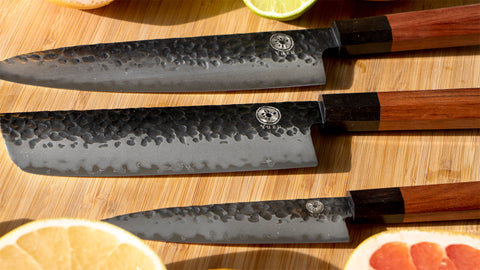
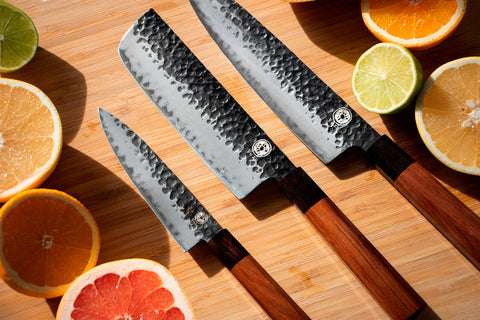
Yuzu knives use AUS-10 in a San-Mai build with a Kurouchi (blacksmith's) finish on the outer layers. The dark, textured finish also adds corrosion resistance and reduces food sticking to the blade.
Heat treatment
The same steel from the same manufacturer, heat-treated by two different knife makers, can produce blades with noticeably different performance. Good heat treatment gets the most out of the steel. Poor heat treatment wastes it. A well-treated AUS-10 blade will outperform a poorly treated VG-10 blade every time.
This is why comparing steels on a spec sheet only tells part of the story. The maker's skill in heat treatment, grinding, and blade geometry determines how the steel actually performs in your hand.
Which steel should you choose?
Choose AUS-10 if:
- You sharpen your own knives and want the process to be quick and easy
- You cook daily and want a blade that forgives imperfect technique
- You value toughness and don't want to worry about micro-chips
- You want strong performance without paying a premium
- You're buying your first serious Japanese kitchen knife
Choose VG-10 if:
- Maximum edge retention is your top priority
- You're comfortable spending more time sharpening (or you pay for professional sharpening)
- You have careful technique and rarely stress the blade laterally
- You do precision cutting that benefits from the finest possible edge
For most home cooks and working chefs, AUS-10 is the more practical choice. It does everything well, forgives mistakes, and takes minutes to sharpen. VG-10 rewards skill and patience with slightly better edge performance, but you pay for it in sharpening time and chip risk.
How to maintain AUS-10 and VG-10 knives?
Both steels are stainless, so maintenance is straightforward. The basics are the same regardless of which steel you choose:
- Hand wash and dry immediately. Never put Japanese knives in a dishwasher.
- Use a wooden or plastic cutting board. Glass and stone destroy edges fast.
- Store in a knife sheath (saya), on a magnetic strip, or in a knife block. Never loose in a drawer.
- Sharpen on a dual-sided 1000/6000 grit whetstone. Start on the 1000-grit side to set the edge, finish on 6000 for polish.
The only real difference: VG-10 takes longer to sharpen. Budget roughly 5 minutes per side for AUS-10, closer to 8-10 for VG-10. Both steels should be sharpened at a 15-degree angle per side, which is the same angle Japanese knives are ground to at the factory.
So which one?
AUS-10 and VG-10 are both good steels. The gap between them is smaller than most marketing would have you believe. What matters more is the knife's construction, heat treatment, blade geometry, and how well you look after it.
If you want a gyuto that you can sharpen in a few minutes and use hard every day without worry, AUS-10 in a San-Mai build is tough to beat. If you want the longest possible edge retention and don't mind the sharpening trade-off, VG-10 has a genuine edge there.
For a deeper look at how AUS-10 compares to other Japanese knife steels, including Blue Paper, White Paper, and standard stainless, read our full Japanese knife steel guide.