
Japanese Knife Brands: Who Actually Makes the Best Blades?
There are hundreds of brands selling Japanese knives. Some have been forging blades for centuries. Others are newer brands building knives around Japanese steel and traditional construction methods. Telling them apart takes more than reading marketing copy.
This guide breaks down the Japanese knife brands worth knowing, what separates them, and what to actually look for when choosing one. Whether you want a handmade single-bevel yanagiba or a solid everyday gyuto, the brand behind the knife matters as much as the steel inside it.
What makes Japanese knives different from Western blades?
Japanese steel knives are built differently from their Western counterparts. The differences start with steel hardness. Most Japanese knives run between 58 and 65 HRC on the Rockwell scale, compared to 54-58 for German brands like Wusthof or Zwilling. That extra hardness allows thinner blade geometry and sharper cutting edges, but it also means the steel is less forgiving if you twist the blade sideways into a bone.
Then there's specialisation. German brands tend to make one knife shape that does everything acceptably. Japanese knife makers produce dozens of blade profiles, each designed for a specific task. A nakiri for vegetables, a gyuto for general prep, a petty for detail work, a deba for breaking down fish. That kind of specialisation comes from centuries of professional cooks using the right knife for the right job.
The forging tradition matters too. Many Japanese knife makers still use techniques handed down through generations of blacksmiths. San-Mai construction, where a hard steel core is clad between softer outer layers, is common in Japanese bladesmithing and almost unheard of from Western manufacturers.
The major knife-making regions in Japan
Geography tells you a lot about a Japanese knife brand. Most established makers are clustered in a handful of regions, each with its own traditions and specialities.
Sakai (Osaka Prefecture)
Sakai has been making blades for over 600 years, originally producing swords before shifting to kitchen knives. Today roughly 90% of Japan's professional-grade single-bevel knives come from Sakai. The production process here is famously divided among specialists: one person forges the blade, another sharpens it, another makes the handle. That division of labour means each step gets decades of focused expertise.
Notable Sakai brands include Sakai Takayuki, Sakai Ichimonji Mitsuhide, and Masamoto Sohonten (the Sakai branch, not to be confused with the Tokyo Masamoto).
Seki (Gifu Prefecture)
Seki is the volume capital of Japanese knife production. Where Sakai focuses on traditional hand-forged blades, Seki has scaled up with modern manufacturing. Major brands like Shun, Global, and KAI all produce knives here. Seki blades tend to use stainless or semi-stainless steels and lean toward mass-market consistency over artisan character.
Tsubame-Sanjo (Niigata Prefecture)
Known for metalworking broadly, this region produces brands like Tojiro. The local approach mixes industrial precision with artisan finishing.
Takefu (Fukui Prefecture)
Home to the Takefu Knife Village, a cooperative of independent blacksmiths sharing a workshop. Brands from here tend to produce small-batch, hand-forged knives using traditional steels like Aogami (Blue Paper) and Shirogami (White Paper).
What to look for before choosing a brand
Brand names matter less than you'd think. These four things tell you more about a knife than the logo on the box.
Steel type
The steel a brand uses tells you most of what you need to know about edge retention, sharpening difficulty, and maintenance demands. Stainless options like VG-10 and AUS-10 resist rust and sharpen easily. High-carbon steels like Blue Paper and White Paper take a finer edge but rust quickly if you do not dry them after use. Powder steels like SG2/R2 combine the best of both worlds but cost significantly more.
For most home cooks, AUS-10 at HRC 58-60 hits the practical sweet spot: hard enough for excellent edge retention, tough enough to resist chipping, and easy to maintain on a whetstone without specialist skills.
Construction method
San-Mai (three-layer) construction is the best balance for most cooks: a hard cutting core protected by softer, corrosion-resistant outer layers. You get sharp cutting performance without the fragility of a mono-steel blade. Machine-made knives from Seki brands are consistent but often skip this construction in favour of simpler stamped or single-layer blades. Hand-forged knives from Sakai or Takefu have character but cost more and can have minor cosmetic variations.
Handle style
Traditional Japanese (wa) handles are lighter and let the blade do the work. Western (yo) handles add bolster weight and feel more familiar to European cooks. Neither is objectively better. If you have not used a wa handle before, the lighter balance takes a few sessions to get used to, but most people prefer it once they adapt.
Handle materials vary widely. Budget brands use plastic or compressed wood, which feels cheap and can degrade with moisture. Quality brands use hardwoods like ebony or sandalwood that develop character over time and provide a more secure grip.
Intended use
A sushi chef needs a single-bevel yanagiba from a Sakai specialist. A home cook who wants one all-purpose knife needs a double-bevel gyuto from a brand that works with stainless steel. Match the brand to the task, and match the knife type to your cooking. Brands that specialise in what you need will always outperform brands that try to cover everything.
Japanese knife brands compared
The Japanese knife market is broad. Here is how the major brands stack up, what they're good at, and where they fall short.
Yuzu Knives
Price range: £75-£109 (individual knives), £115-£299 (starter kits and sets)
Steel: AUS-10 (HRC 58-60), San-Mai construction
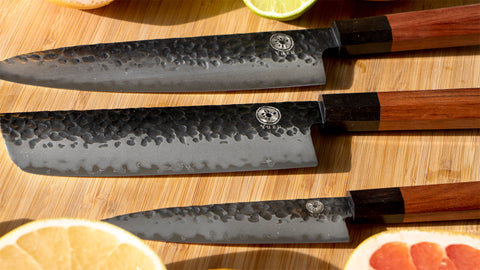
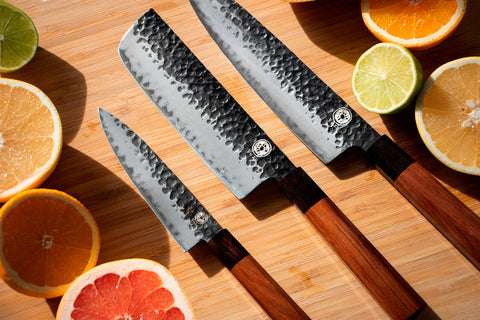
Yuzu uses AUS-10 Japanese steel in San-Mai (three-layer) construction with a Kurouchi blacksmith's finish and traditional wa handles in ebony and sandalwood. Every knife is sharpened to a 15-degree edge at the factory.
That combination gives you the steel quality and blade construction you'd normally find at much higher price points. Where many brands in this range cut corners on handles (plastic composites, compressed wood) or skip San-Mai construction entirely, Yuzu puts the same emphasis on the handle and finish as on the blade itself. The Kurouchi finish is functional too: the textured surface reduces food sticking and adds natural rust protection.
The range covers the four knife types most home cooks need: a gyuto for general prep, a nakiri for vegetables, a petty for detail work, and a bread knife for crusty loaves. Available as a four-knife set for £299 (saving £103 over buying individually) or a three-knife set for £229.
Yuzu also sells what most brands don't: the complete setup. The starter kits (from £115) bundle a knife with a dual-sided whetstone and a wooden saya sheath, so you have everything you need from day one. Most other brands sell the knife alone and leave you to figure out maintenance and storage separately.
Tojiro
Price range: £50-£200
Steel: VG-10, DP Cobalt Alloy
Tojiro is based in Tsubame-Sanjo and is one of the most commonly recommended entry-level brands. Their DP series uses VG-10 steel at around 60 HRC. The cutting performance is solid for the price, but the handles are a known weak point: basic plastic or compressed wood that feels noticeably cheaper than what you get from brands with proper wa handles. If you're just testing whether Japanese knives are for you and don't mind upgrading later, Tojiro is functional.
MAC
Price range: £60-£180
Steel: Proprietary high-carbon stainless
MAC has been making knives since 1964 and their Professional series is well-regarded in commercial kitchens. The blades are thin and arrive with an aggressive edge out of the box. The styling is plain, and the handles are Western-style, so if you're looking for the traditional Japanese knife experience, MAC isn't the best fit. They also don't offer San-Mai construction or the kind of finishing details you get from brands that lean into Japanese forging tradition.
KAI / Shun
Price range: £100-£300
Steel: VG-MAX (Shun Premier), AUS-10A (Seki Magoroku)
KAI Corporation is one of the largest knife manufacturers in Japan, founded in 1908 in Seki City. Their Shun line targets the premium home cook market with Damascus-clad blades and Pakkawood handles. VG-MAX steel runs at 60-61 HRC. The knives look good, but you pay a significant premium for the brand name, packaging, and marketing. KAI's Seki Magoroku line uses similar steel at lower prices but with less visual flair. VG-MAX can also be more prone to micro-chipping than AUS-10 under lateral stress.
Global
Price range: £70-£200
Steel: CROMOVA 18 stainless
Global's knives look nothing like traditional Japanese blades. The hollow stainless steel handle is welded directly to the blade with no seams or bolsters. The steel sits around 56-58 HRC, which is softer than most Japanese brands. That means they dull faster and can't hold the kind of acute edge you get from harder steels like AUS-10 or VG-10. Global is more of a modern design statement than a performance-oriented Japanese knife. People either love or hate the handle feel.
Miyabi
Price range: £150-£400
Steel: FC61, MC66 (SG2/R2 micro-carbide), CMV60
Miyabi is owned by Zwilling (the German knife brand) and manufactured in Seki. The result is a hybrid: Japanese steel types with Western-style handles and bolster designs. Their top-tier Birchwood series uses SG2 powder steel at 63 HRC. They're well-made, but the Western handle and bolster add weight that undermines the light, blade-forward balance most people look for in a Japanese knife. They're also expensive for what is essentially a mass-produced Seki knife with a German parent company's margins built in.
Masamoto Sohonten
Price range: £200-£800+
Steel: High-carbon White Steel (Shirogami), Swedish stainless
Masamoto is one of the oldest knife makers in Japan, with roots going back to the 1800s in Sakai. Their hand-forged high-carbon knives are used in high-end sushi restaurants. The edge quality is exceptional but the knives demand serious upkeep. High-carbon steel will rust if left wet even briefly and needs regular sharpening on a whetstone. The price point also puts them firmly in professional and collector territory, not everyday home cooking.
Yoshihiro
Price range: £150-£700
Steel: VG-10, Blue Steel #2, White Steel #2, SG2
Yoshihiro has a wide range, from entry-level VG-10 gyutos to hand-forged Blue Steel yanagibas. They source from multiple workshops in Sakai and Seki, which means quality varies across product lines. You need to know which specific line you're buying from. The brand name alone doesn't guarantee consistency.
Sakai Takayuki
Price range: £100-£600
Steel: VG-10, Aogami (Blue Steel), R2/SG2
Sakai Takayuki follows the traditional Sakai division of labour: one craftsman forges the blade, another sharpens it, another fits the handle. For professional-grade single-bevel knives (deba, yanagiba, usuba), they're well-respected. Their double-bevel knives are competent but don't stand out in a crowded mid-range field.
Misono
Price range: £100-£350
Steel: Swedish stainless, UX10 (semi-stainless)
Misono is popular among professional chefs, particularly their UX10 series in semi-stainless Swedish steel. The knives are plain-looking, with no Damascus patterns or premium handle materials. That no-frills approach keeps costs down but also means you're not getting much beyond the steel itself for the price.
Price vs. quality: what you actually get at each price point
Japanese knives range from around £40 to well over £1,000. Here is what each bracket typically gets you.
Under £80: Machine-finished stainless steel with basic handles. Tojiro and KAI's entry lines sit here. Cutting performance is acceptable, but the handles and overall fit-and-finish feel like budget products. These work for testing whether you like Japanese knives, but most people upgrade within a year.
£80-£200: The sweet spot for most cooks. This is where you find properly hardened steel (AUS-10, VG-10), San-Mai construction, and handles worth holding. A well-chosen knife in this range gives you professional-level cutting performance without specialist maintenance. The Yuzu Gyuto at £109 sits here: AUS-10 San-Mai with an ebony and sandalwood wa handle, a Kurouchi finish, and a 15-degree factory edge.
£200-£500: Hand-forged blades, premium steels (SG2, Blue Steel #2), artisan finishing. The knives are better, but the gap narrows the higher you go. Most of the improvement is in finishing and aesthetics rather than cutting performance.
£500+: Custom and collector territory. Hand-forged by named blacksmiths, often with months-long waitlists. The performance ceiling is real but narrow. At this point you are paying for the maker's name and craft as much as for cutting ability.
Sharpening and maintenance
Every Japanese knife needs regular sharpening on a whetstone and should never go in the dishwasher. That said, some steels and brands demand more upkeep than others. Stainless steel knives (VG-10, AUS-10, CROMOVA) need sharpening every few weeks with casual home use, and the right sharpening stone depends on your steel. High-carbon knives need drying immediately after washing and will develop a patina over time.
A wooden saya protects the blade edge during storage and is worth adding regardless of the brand you choose. Most brands sell knives without one, so you'll need to source storage separately, or pick a brand that includes it as part of the package.
Frequently asked questions
What is the best Japanese knife brand for beginners?
Look for a brand that uses quality stainless steel (AUS-10 or VG-10), proper San-Mai construction, and includes or offers the maintenance essentials (a whetstone and saya). The Yuzu starter kits (from £115) bundle a knife with a whetstone and saya, so you have everything from day one without having to research accessories separately. Tojiro's DP series is another common entry point if you're looking for the lowest price possible, though you'll need to source a whetstone and sheath separately, and the handles are basic plastic.
Are expensive Japanese knives worth the money?
Up to about £200, each price jump brings noticeable improvements in steel quality and how the knife feels in your hand. Above that, you are paying for hand-forging and artisan finishing that matters more to collectors and professional chefs than to home cooks. A well-made £100 Japanese knife will outperform a £300 Western knife in most kitchen tasks.
Should I buy carbon steel or stainless steel?
If you will dry the knife immediately after every use and enjoy maintaining your tools, carbon steel rewards you with a sharper edge. If you want something lower maintenance, stainless options like VG-10 or AUS-10 are the practical choice. Most home cooks are better served by stainless.
What Japanese knife should I buy first?
A gyuto (Japanese chef knife) in the 200-210mm range. It handles 80-90% of kitchen tasks: slicing meat, chopping vegetables, mincing herbs, breaking down poultry. Every major Japanese knife brand makes one, and it is the single best knife to learn Japanese cutting technique on. From there, you can build a set around it.
Can I put Japanese knives in the dishwasher?
No. The high water temperature, harsh detergent, and rattling against other items will damage the edge and can cause handle cracking or steel discolouration. Hand wash with warm water and mild soap, dry immediately, and store in a saya or on a magnetic rack.