
How to Choose the Best Kitchen Knife (Without Overthinking It)
The best kitchen knife is the one that fits how you cook. Not the one with the most reviews, the flashiest Damascus pattern, or the biggest price tag.
A good knife should feel natural in your hand, hold its edge long enough to be useful, and handle whatever you throw at it without complaint. Everything else is noise.
This guide covers the things that actually affect how a knife performs, so you can stop scrolling through product roundups and start cooking with a knife that works for you.
Start With What You Cook
Before thinking about steel types or handle materials, think about what sits on your cutting board most nights. The knife you need depends on the food you prepare, not on what a reviewer tested in a studio kitchen.
If you cook a bit of everything (proteins, vegetables, herbs) you need a chef's knife or gyuto. This is the 80% knife. It handles everything from mincing garlic to portioning a chicken breast. A 200-210mm blade works well for most home cooks.
If vegetables dominate your cooking, a nakiri is worth a look. The flat blade sits flush against the cutting board, so every downward cut goes clean through. No rocking, no half-cuts.
For small, precise work (peeling fruit, deveining prawns, trimming fat) a petty knife fills the gap a larger blade can't reach. And if you bake or buy crusty bread regularly, a good serrated bread knife saves you from crushing your loaves.
Most home cooks need two knives: a chef's knife and a petty. Everything else is a welcome addition, not a requirement.
What Actually Makes a Kitchen Knife Good?
Walk into any knife shop and you'll hear about blade steel, HRC hardness, and forging techniques. Here's what those things actually mean for your cooking.
Steel
Steel determines how sharp the knife gets, how long it stays sharp, and how much maintenance it needs.
Japanese steels like AUS-10 and VG-10 are harder (58-62 HRC), which means they take a sharper edge and hold it longer. But they can chip if you twist the blade or cut through bone.
German stainless steels sit around 56-58 HRC. They're tougher and more forgiving, but they dull faster and can't take as fine an edge.
For most home cooks, a Japanese steel in the 58-60 HRC range is a good middle ground. Hard enough to stay sharp for weeks, tough enough that you don't have to baby it.
Blade Geometry
This matters more than steel, and almost nobody talks about it. Two knives made from the same steel will cut completely differently depending on how thin the blade is ground.
Thinner blades glide through food with less resistance. Thicker blades are more durable but need more force. Japanese knives typically run 1.5-2mm at the spine, while Western knives sit around 2.5-3mm.
If you want clean, effortless cuts on vegetables and boneless proteins, look for a thin blade with a flat or convex grind.
Edge Angle
Japanese knives are sharpened to 12-15° per side. Western knives to 20-22°. That difference is significant in everyday use.
A lower angle produces a sharper edge that slices rather than pushes through food. The downside is a slightly more delicate edge. Avoid bones and frozen food, and you won't have problems.
Handle and Balance
This is personal and hard to get right from a spec sheet. Some people prefer the lighter feel of a Japanese wa handle, which is octagonal wood that lets the blade do the work. Others want the heavier, bolstered grip of a Western handle.
The only real rule: the knife should feel balanced in your hand, not blade-heavy or handle-heavy. If you can, hold one before buying.
Japanese Kitchen Knives vs Western: Which Is Better?
Neither. They're built for different cooking styles, and the right choice depends on what you do in the kitchen.
Japanese knives are lighter, sharper, and ground thinner. They're better at precision work and clean cuts. If you cook with a lot of vegetables, fish, or boneless proteins, a Japanese kitchen knife will feel noticeably different from what you're used to.
Western knives are heavier and more forgiving. They handle harder ingredients and rougher techniques without chipping. If you regularly cut through joints, frozen food, or just want something less delicate, a Western blade makes more sense.
Most serious home cooks end up owning at least one of each. But if you're buying your first good knife and you don't regularly hack through bones, a Japanese blade will probably impress you more. The precision is noticeable from the first onion you slice. If you go Japanese, our brand comparison covers who makes what.
For a full comparison, read our breakdown of Japanese vs German kitchen knives.
How Much Should a Good Kitchen Knife Cost?
You can get a genuinely good kitchen knife for £60-£120. That's where quality steel, decent blade geometry, and proper heat treatment converge without you paying for prestige.
Under £40, you're usually getting soft steel that dulls within a few uses. It'll work, but you'll be sharpening constantly and the cuts will never feel effortless.
£60-£120 is where most of the value sits. Knives in this range use properly hardened steel (58+ HRC), have thinner grinds, and hold their edge for weeks of regular home cooking. You don't need to spend more unless you specifically want premium finishing or rare steels.
Above £200, you're paying for hand-finishing, single-origin steels, or collector appeal. The performance gains over a £100 knife are marginal for everyday cooking.
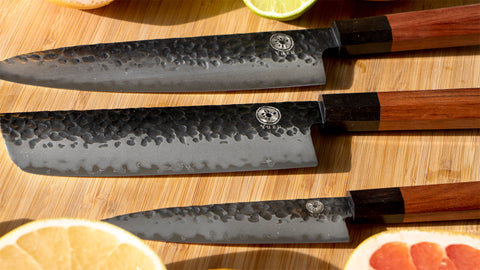
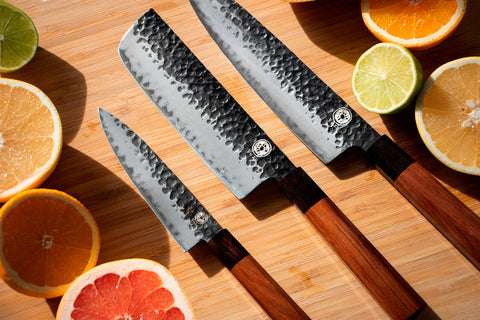
Our Gyuto at £109 lands right in that range. AUS-10 steel at HRC 58-60, san-mai three-layer construction, a 15° edge, and an ebony and sandalwood wa handle.
Do You Need a Knife Set?
Probably not the kind you're picturing. The 15-piece block sets sold at department stores fill drawers with knives you'll never touch, and the quality gets spread thin across too many blades.
A better approach: buy two or three individual knives that you'll actually reach for. A chef's knife, a petty knife, and a bread knife covers 95% of kitchen work.
If you do want a set, look for one that bundles only knives you'll use. A well-curated three or four knife set saves money over buying individually and skips the filler pieces. Our guide to building a Japanese knife set covers how to pick the right combination.
Keeping Your Kitchen Knife Sharp
A sharp knife is a safe knife. Dull blades slip off food, need more force, and make cooking frustrating.
The best way to maintain any kitchen knife is with a whetstone. It takes 10-15 minutes every few weeks and gives you full control over the edge angle and finish. A dual-sided stone (one coarse grit, one fine) is all you need. For a full walkthrough, see our step-by-step whetstone guide.
Pull-through sharpeners and electric sharpeners are convenient, but they strip too much metal and can't match the edge a whetstone produces. Honing rods are fine for softer Western steel but can chip harder Japanese blades.
Beyond sharpening:
- Hand wash and dry your knives straight after use
- Store them in a saya, on a magnetic strip, or in a knife block. Never loose in a drawer
- Use wood or plastic cutting boards. Glass, marble, and ceramic will wreck the edge
- Never put kitchen knives in the dishwasher
Choosing the Right Kitchen Knife
The best kitchen knife isn't about brand names or spec sheets. It's the one that matches how you actually cook.
Start with a good chef's knife or gyuto. Add a petty knife for detail work. Pick something with properly hardened steel, a thin blade, and a handle that feels balanced in your grip. Spend £60-120 and you'll have a knife that outperforms most of what you'll find in restaurant kitchens.
Take care of it (sharpen on a whetstone, hand wash, store it properly) and it will last you decades.